


Industrial Mailing Tubes | Cardboard Shipping Containers
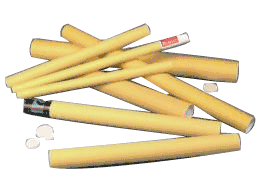
- Material Composition: Spiral-Wound Kraft Paperboard.
- Size/Capacity Range: 1.5" to 3" Diameters; 15" to 36" Lengths.
- Compliance/Ratings: Rigid Wall Construction for USPS, UPS, and FedEx Shipping.
- Closure Types: Plastic End Caps (Friction Fit).

| Product Description | Diameter | Length | Quantity |
|---|---|---|---|
| Mailing Tubes 1 1/2" x 15" | 1.5" | 15" | 25 Case Pack |
| Mailing Tubes 1 1/2" x 18" | 1.5" | 18" | 25 Case Pack |
| Mailing Tubes 1 1/2" x 24" | 1.5" | 24" | 25 Case Pack |
| Mailing Tubes 2" x 15" | 2.0" | 15" | 25 Case Pack |
| Mailing Tubes 2" x 18" | 2.0" | 18" | 25 Case Pack |
| Mailing Tubes 2" x 24" | 2.0" | 24" | 25 Case Pack |
| Mailing Tubes 2" x 36" | 2.0" | 36" | 25 Case Pack |
| Mailing Tubes 2 1/2" x 18" | 2.5" | 18" | 25 Case Pack |
| Mailing Tubes 2 1/2" x 24" | 2.5" | 24" | 25 Case Pack |
| Mailing Tubes 2 1/2" x 36" | 2.5" | 36" | 25 Case Pack |
| Mailing Tubes 3" x 24" | 3.0" | 24" | 25 Case Pack |
| Mailing Tubes 3" x 36" | 3.0" | 36" | 25 Case Pack |
Structural Design and Dimensional Variety Industrial mailing tubes are defined by two primary dimensions: internal diameter and usable length. Smaller 1.5-inch diameter tubes are optimized for thin posters and lightweight documents, minimizing dimensional weight shipping costs. Mid-range 2-inch and 2.5-inch options provide additional volume for thicker paper stocks or multiple sheets. The 3-inch diameter configurations are reserved for large-format graphics and heavier textiles. The length of the tube must exceed the width of the contents by at least one inch to accommodate the depth of the plastic end caps, which sit flush inside the tube ends to prevent shifting during mechanical sorting.
Spiral-Wound Paperboard Construction The durability of a mailing tube is derived from its manufacturing process, where multiple layers of kraft paperboard are wound spirally around a fixed mandrel. This technique creates a continuous, seamless cylinder with high beam strength, preventing the tube from bending or snapping under pressure. The thickness of the tube wall is calibrated to the diameter to maintain a consistent strength-to-weight ratio. Standard kraft exteriors provide a high-friction surface that facilitates labeling and adhesive tape adhesion, while the smooth interior prevents surface abrasion on sensitive printed materials or photographic emulsions.
Shipping Compliance and Protection These tubes meet the structural requirements for major commercial carriers, including USPS, FedEx, and UPS. Unlike flat envelopes or lightweight poly-mailers, the rigid cylindrical shape of these containers ensures they do not fall under "non-machinable" surcharges for thickness, provided they meet length requirements. The paperboard is designed to withstand the compressive forces of automated sorting facility belts. Furthermore, the use of tight-sealing plastic end caps provides a moisture-resistant barrier at the openings, shielding contents from environmental exposure during the "last mile" of delivery.
Professional and Commercial Use Cases In the architectural and engineering sectors, mailing tubes are the standard for transporting blueprints, CAD drawings, and site plans. Legal and administrative offices utilize these containers for historical documents and certificates that cannot be creased. In the retail and e-commerce space, they are used for fulfilling orders of fine art prints, movie posters, and maps. Beyond paper goods, industrial manufacturers utilize heavy-duty tubes for shipping narrow metal components, plastic rods, and specialized laboratory equipment that requires a protective outer shell against impact.
Technical Factors for Procurement When selecting a mailing tube, the primary technical consideration is the "curl" or "memory" of the material being inserted. Smaller diameters require a tighter roll, which can stress fibers in heavy-gauge paper; therefore, 3-inch tubes are recommended for premium stocks. Buyers must also account for the wall thickness; larger diameter tubes typically require thicker walls to prevent "ovalling" or collapsing when stacked. Compatibility with end caps is critical; standard sizes utilize friction-fit caps, but for high-security or heavy contents, stapling the cap through the paperboard wall is a common industrial practice to ensure total closure integrity.

