


Industrial Chemical Proportioners | Wall & Drum Mount Units
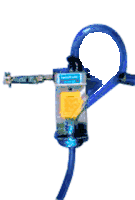
- Material Composition: Polypropylene, EPDM, and Stainless Steel components.
- Flow Rate Range: 2.5 GPM to 16.8 GPM (Gallons Per Minute).
- Mounting Configurations: Wall-mount and versatile Wall/Drum-mount options.
- Induction Technology: Venturi-based vacuum dilution systems.

| Product Name | Flow Rate (GPM) | Mounting Type |
|---|---|---|
| Wall Mount 4.8 GPM - Proportioners | 4.8 | Wall Mount |
| Wall or Drum Mount 4.8 GPM - Proportioners | 4.8 | Wall or Drum |
| Wall or Drum Mount 2.5 GPM - Proportioners | 2.5 | Wall or Drum |
| Wall or Drum Mount 9.8 GPM - Proportions | 9.8 | Wall or Drum |
| Wall or Drum Mount 16.8 GPM - Proportioners | 16.8 | Wall or Drum |
Mounting and Portability Configurations Industrial proportioners are categorized by their mounting infrastructure: wall-mount or drum-mount. Wall-mount units are fixed installations designed for centralized chemical dispensing stations, utilizing a dedicated water line connection. Drum-mount configurations provide increased mobility, attaching directly to the bung of a 55-gallon drum or the rim of a chemical tote. Many units in this category utilize a hybrid wall-or-drum mount design, allowing facility managers to reconfigure the dispensing point based on fluid consumption rates. This versatility ensures that the induction system remains in close proximity to the chemical source, reducing the length of suction tubing required and maintaining vacuum integrity.
Component Durability and Chemical Resistance The internal components of a proportioner must withstand continuous exposure to aggressive chemical concentrates. The bodies are typically molded from glass-filled polypropylene for high impact strength and chemical inertness. Critical seals and O-rings are fabricated from EPDM (Ethylene Propylene Diene Monomer) or Viton, depending on the pH levels of the chemicals being processed. For high-flow units like the 16.8 GPM models, the venturi inserts are often reinforced to prevent erosion from high-velocity water streams. These material choices prevent stress cracking and chemical degradation, ensuring the long-term accuracy of the dilution ratio.
Compliance and Backflow Prevention To meet plumbing codes and environmental safety regulations (such as those established by OSHA and local water authorities), industrial proportioners must incorporate backflow prevention. Most units feature integrated air gaps or mechanical check valves to prevent chemical concentrates from siphoning back into the potable water supply. Compliance with these standards is mandatory in food processing and healthcare environments to prevent cross-contamination. Furthermore, the use of color-coded metering tips allows for standardized dilution ratios that align with manufacturer-specified Safety Data Sheets (SDS), ensuring that the final solution remains within legal concentration limits for worker safety.
Sector-Specific Deployment The application of proportioners spans several technical sectors. In the food and beverage industry, low-flow 2.5 GPM units are used for dispensing sanitizers into buckets or sinks, while 9.8 GPM units are deployed for foaming applications in large-scale facility cleaning. In agricultural settings, high-flow 16.8 GPM proportioners are utilized for filling large pesticide sprayers or irrigation tanks. The automotive and manufacturing sectors utilize these units for the precise mixing of coolants and degreasers, where maintaining a specific concentration is critical to preventing tool corrosion or part failure during the machining process.
Technical Factors for Implementation Selecting a proportioner requires an analysis of water pressure and desired output volume. Venturi systems require a minimum PSI (typically 20-30 PSI) to create the vacuum necessary for chemical induction. Buyers must match the flow rate of the unit to the receiving vessel; high GPM units are inefficient for small bottles due to excessive splashing and turbulence, whereas low GPM units are inefficient for large reservoirs. Additionally, chemical viscosity must be considered; highly viscous fluids may require specialized large-bore suction tubing or specific metering tips to ensure the venturi effect remains strong enough to pull the concentrate consistently into the water stream.

