


Drum Inspection Lights | Explosion-Proof & Industrial
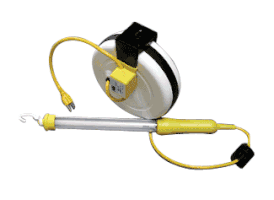
- Material Composition: Aluminum housings, tempered glass lenses, and chemical-resistant cords.
- Illumination Range: 10-watt to 100-watt outputs with high-intensity focused beams.
- Compliance/Ratings: Class I, Division 1 (Explosion-Proof) and general industrial safety ratings.
- Power Configurations: Battery-operated, straight-corded, and coiled-corded 120V models.

Featured Products
| Product Name | Configuration | Cord Type |
|---|---|---|
| Drum Inspection and Work Light | Dual-Purpose Heavy Duty | Industrial Grade Straight |
| Coil Corded - Drum Inspection Midget Lights | Slim Profile (3/4" Bung) | Retractable Coiled Cord |
| Drum Inspection Midget Lights, 15 Watt | Slim Profile (3/4" Bung) | 25' Straight Cord |
Specialized Light Profiles and Dimensions Industrial drum inspection lights are categorized by their physical diameter and reach, tailored to standard container apertures. "Midget" lights feature slim-profile heads designed specifically to pass through 3/4" NPT bung openings without risk of obstruction. Larger "Mighty" lights or work-light hybrids provide broader lumen output for open-head drums or large-scale tanks. The mechanical configuration often includes flexible goosenecks or rigid shafts, allowing the light source to be positioned deep within the drum cavity to eliminate shadows and provide a 360-degree view of the interior walls and bottom seams.
Housing Durability and Thermal Management The construction of inspection lights utilizes non-sparking materials, such as specialized aluminum alloys or high-impact plastics, to prevent ignition in volatile environments. Lenses are typically manufactured from tempered, heat-resistant glass or shatter-proof polycarbonate to withstand the thermal output of high-wattage bulbs. For corded units, the jacket material (such as SJTO or SOOW) is selected for resistance to oils, acids, and solvents commonly found in industrial cleaning or chemical manufacturing. Internal components are often shock-mounted to protect the filament or LED array from drops or rough handling during repeated insertion cycles.
Safety Ratings and Hazardous Location Compliance In environments where flammable vapors or dust are present, equipment must adhere to National Electric Code (NEC) standards. Explosion-proof drum lights are rated Class I, Division 1, Groups C and D, indicating they are designed to contain an internal explosion and prevent the exterior surface from reaching temperatures that could ignite the surrounding atmosphere. Non-explosion-proof models are suitable for general-purpose inspections but must still meet OSHA safety standards for corded electrical equipment. Proper grounding and the use of low-voltage transformers are common technical requirements to ensure operator safety during the inspection of conductive metal barrels.
Sector-Specific Inspection Protocols The use of specialized lighting is critical across several technical sectors. In the food and beverage industry, lights are used to verify the cleanliness of reconditioned stainless steel drums to prevent cross-contamination. In the chemical and petroleum sectors, inspection lights facilitate the detection of interior lining degradation or "pinhole" rust spots that could lead to hazardous leaks. Agricultural applications utilize these tools to ensure that storage vessels for pesticides or fertilizers are free of moisture or previous chemical residue before refilling, maintaining product purity and compliance with environmental regulations.
Technical Factors for Equipment Acquisition Selecting the appropriate inspection light requires an analysis of the storage environment and the container type. Buyers must determine if the atmosphere requires an intrinsically safe or explosion-proof rating. Secondarily, the choice between straight and coiled cords depends on the mobility required; coiled cords prevent tripping hazards in tight workspaces, while long straight cords offer greater range for large-scale tank farms. Finally, light intensity (measured in watts or lumens) must be balanced against the duration of use to prevent overheating in confined spaces, ensuring the light remains within safe operating temperatures during extended inspection cycles.

