


Industrial Glass Bottles and Jars | Clear Flint Glass
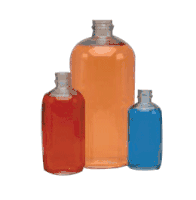
We have glass bottles and jars in various shapes and sizes. They all have flint (clear) color that appeals for both decoration and packaging purposes. Economy glass jars – available in 4 to 24 case packs – are especially great if you want to get the best out of limited budget. However, the straight-sided glass jars and the French square glass jars could add a twist and a selling point to your products.
In the mean time, if the stored item is supposed to be pure and secure in the jars for extended time, you will want to have these special jars equipped with chemical resistant phenolic screw cap. These jars will ensure your products stay intact and pure for a long time.
Or perhaps you prefer bottles to jars? Then choose the Boston round glass bottles for your liquid or powder products.
Closures Dimensions
Bottle Finish Dimensions
Interested? email us for further assistance.

| Product Category | Material | Common Shape | Standard Closure Type |
|---|---|---|---|
| Economy Glass Jars | Flint Glass | Round/Cylindrical | Continuous Thread |
| Boston Round Glass Bottles | Flint Glass | Round Shoulder | Narrow Neck / Screw Cap |
| Straight Sided Glass Jars | Flint Glass | Wide Mouth / Straight Wall | Continuous Thread |
| French Square Glass Jars | Flint Glass | Square / Rectangular | Wide Mouth |
| Misc. Glass Jars | Flint Glass | Varies | Phenolic / Specialized |
Industrial Glass Container Geometries Glass containers are categorized by their neck finish and body geometry. Boston Round bottles feature a rounded shoulder and a rounded base, making them suitable for liquid products that require easy pouring and minimal residue retention. Straight-sided jars lack a shoulder, providing a wide-mouth opening that facilitates the storage and retrieval of solid samples, powders, or viscous substances. French Square jars utilize a square footprint to maximize shelf space efficiency and provide four flat surfaces for high-visibility labeling. Economy jars are standard cylindrical vessels designed for bulk packaging where specialized geometry is secondary to volume capacity and cost-efficiency.
Chemical Properties of Flint Glass Flint glass, or Type III soda-lime glass, is the industrial standard for clear containers due to its transparency and chemical durability. It is manufactured using high-purity silica sand, soda ash, and limestone. The non-reactive nature of glass prevents ion exchange and leaching, which is critical for maintaining the purity of sensitive chemical reagents and food products. For applications involving aggressive chemicals, glass containers are paired with phenolic closures. Phenolic resin is a thermosetting plastic that provides high heat resistance and chemical stability, often integrated with LDPE or PTFE liners to create a hermetic seal.
Compliance and Measurement Accuracy Industrial glass packaging must adhere to strict dimensional standards to ensure closure integrity. The "T" dimension (major diameter of the thread) and "E" dimension (minor diameter of the thread) determine the compatibility between the bottle finish and the cap. The "H" dimension, measured from the top of the finish to the shoulder, ensures the closure skirt does not bottom out before the liner is compressed. These containers are FDA-compliant for food-grade storage and meet General Requirements for packaging substances that do not require UN-rated hazardous material certification. Proper thread engagement, influenced by the "S" dimension, is required to prevent leakage during transit.
Sector-Specific Utility The utility of flint glass extends across multiple technical sectors. In laboratory settings, Boston Round bottles are used for solvent and reagent storage. The pharmaceutical industry utilizes straight-sided jars for the containment of capsules and powdered compounds. In the food and beverage sector, these jars are employed for preserves, spices, and oils, where clarity is required for content inspection. Additionally, the agricultural and manufacturing industries use clear glass jars for soil sampling and lubricant storage, benefiting from the material's resistance to atmospheric degradation and UV exposure when stored in controlled environments.
Technical Factors for Procurement Selecting the appropriate glass container requires an analysis of chemical compatibility and volumetric requirements. Buyers must evaluate the viscosity of the contents; wide-mouth jars are necessary for high-viscosity materials, while narrow-neck Boston Rounds are optimal for low-viscosity liquids. The choice of closure is equally critical; standard polypropylene caps suffice for general use, but phenolic caps with chemical-resistant liners are mandatory for acids or volatile organic compounds. Furthermore, spatial constraints in storage or shipping may dictate the use of French Square jars over round configurations to optimize pallet density and reduce shipping footprints.

