


Class III Combustible Safety Cabinets | Industrial Storage
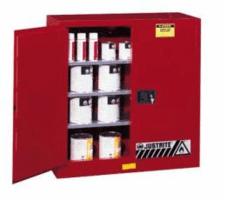
- Material: 18-gauge double-walled welded steel with 1.5-inch insulating air space.
- Capacities: Designed for standard industrial containers, including paint cans and ink pails.
- Compliance: NFPA Code 30, OSHA 1910.106, and FM Approved.
- Closure Types: Manual, self-closing, and sliding self-closing door configurations.

| Product Name | Door Type | Dimensions (H x W x D) |
|---|---|---|
| Safety Storage Cabinets Class III Combustibles Manual doors | Manual | Standard Industrial |
| Safety Storage Cabinets Class III Combustibles Self-closing doors | Self-closing | 44 x 43 x 18 |
| Safety Storage Cabinets Class III Combustibles Sliding self-closing door | Sliding Self-closing | 44 x 43 x 18 |
Door Mechanics and Safety Closures The functionality of safety cabinets is largely determined by the door closure mechanism. Manual doors allow a full 180-degree opening but require the operator to physically close and latch the unit. Self-closing doors are equipped with a fusible link system; in the event of a fire, the link melts at approximately 165°F (74°C), triggering a spring-loaded mechanism that automatically seals the cabinet. Sliding self-closing doors offer a space-saving alternative for narrow aisles, utilizing a track system that also features a fusible link for emergency closure. Both automated options ensure that the cabinet remains sealed when not in use, reducing the accumulation of flammable vapors.
Structural Integrity and Thermal Protection Industrial safety cabinets are fabricated using double-walled 18-gauge cold-rolled steel. The design incorporates a 1.5-inch (38 mm) insulating air space between the inner and outer walls to limit temperature increases within the cabinet during external fire exposure. The exterior is typically finished with a chemical-resistant powder coat to prevent corrosion and degradation from spilled solvents or inks. Internal components include galvanized steel shelves designed to direct spills toward a leak-proof bottom sump, which is engineered to contain a minimum of 2 inches (51 mm) of liquid, preventing environmental contamination and secondary fire spread.
OSHA and NFPA Compliance The storage of Class III combustibles—liquids with flash points at or above 140°F (60°C) and below 200°F (93°C)—is strictly regulated. These cabinets are engineered to meet NFPA Code 30 and OSHA 29 CFR 1910.106 standards. Compliance requires the inclusion of specific safety features, such as three-point stainless steel bullet self-latching systems and built-in grounding lugs to dissipate static electricity. Most units are FM (Factory Mutual) Approved, indicating they have undergone rigorous testing to verify structural stability and fire resistance performance under controlled conditions.
Sector-Specific Utilization Safety cabinets for paint and ink are utilized across diverse sectors where high-viscosity combustibles are prevalent. In the printing industry, they house specialized inks and cleaning solvents. In automotive and manufacturing facilities, they secure paints, lubricants, and finishing chemicals. Because Class III combustibles are less volatile than Class I liquids but still contribute significantly to fire load, these cabinets are essential for organized hazardous material management. They prevent unauthorized access and ensure that localized fires do not escalate by involving bulk chemical storage.
Technical Factors for Procurement When selecting a safety cabinet, the primary consideration is the volume and classification of the liquids being stored. Buyers must calculate the total gallon capacity to ensure it does not exceed local fire code limits for a single protected area. Secondary considerations include floor space availability, which dictates whether a standard swinging door or a sliding door configuration is required. Furthermore, the choice between manual and self-closing doors is often mandated by specific state or municipal fire codes, with many jurisdictions requiring self-closing mechanisms as a baseline for high-risk industrial zones. Chemical compatibility with the cabinet’s interior lining should also be verified for highly corrosive inks or specialty coatings.

