


Flammable Waste Safety Cabinets | Drum & Can Storage
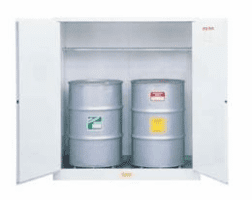
- Material Composition: 18-gauge double-walled welded steel with 1.5-inch insulating air space.
- Size/Capacity Range: 5-gallon pails to 110-gallon (dual 55-gallon) drum configurations.
- Compliance/Ratings: FM Approved; meets OSHA and NFPA Code 30 regulations.
- Closure Types: Manual-close and self-close door options with three-point stainless steel bullet latching.

$899.96
$1,200.00
(You Save 25%)| Product Name | Capacity | Compatible Containers |
|---|---|---|
| Justrite Flammable Waste Cabinets for 6-5 gal. | 30 Gallons | 5-Gallon Cans |
| Justrite Flammable Waste Cabinets 1-55 gallon | 55 Gallons | Single 55-Gallon Drum |
| Justrite Flammable Waste Cabinets 9-5 gallon | 45 Gallons | 5-Gallon Cans |
| Justrite Flammable Waste Cabinets 2-55 gallon | 110 Gallons | Dual 55-Gallon Drums |
| Drum Roller For Flammable Waste Safety Cabinets | N/A | 55-Gallon Drum Accessory |
Structural Design and Door Mechanisms Flammable waste cabinets are configured based on container size and access frequency. Vertical drum cabinets are designed with internal floor tracks or optional rollers to facilitate the movement of heavy 55-gallon barrels. Smaller safety cabinets are tiered with adjustable shelves to maximize the storage of 5-gallon pails or safety cans. Door configurations include manual-close models, which open to a full 180 degrees, and self-close models. Self-close units utilize a fusible link system that automatically triggers the doors to shut and latch if ambient temperatures reach 165°F (74°C), ensuring containment even if the unit is left open during a fire.
Double-Wall Steel and Protective Coatings The engineering of these cabinets centers on thermal resistance and chemical durability. The 18-gauge steel panels are welded to create a 1.5-inch (38-mm) insulating air gap, a design intended to delay internal temperature rise during a fire. The exterior and interior surfaces are finished with a lead-free epoxy/polyester powder-coat paint. This finish provides high resistance to chemical corrosion, solvents, and humidity, preventing structural degradation in harsh industrial environments. All units feature a 2-inch (51-mm) liquid-tight sump at the base, designed to capture leaks and accidental spills from the stored containers.
OSHA, NFPA, and FM Compliance Storage of flammable liquids is strictly governed by OSHA 1910.106 and NFPA Code 30. These regulations dictate that safety cabinets must be designed to limit the internal temperature to no more than 325°F when subjected to a 10-minute fire test. Cabinets in this category are FM (Factory Mutual) Approved, signifying they have undergone rigorous testing to meet these safety thresholds. Furthermore, cabinets include a built-in grounding connector to dissipate static electricity, a critical requirement for compliance when transferring flammable liquids or storing waste that may generate volatile vapors.
Hazardous Waste Management Across Sectors Industrial waste cabinets are utilized in diverse sectors to manage the accumulation of solvent-soaked rags and hazardous liquid waste. In automotive and aerospace manufacturing, they house 55-gallon drums used for spent degreasers and lubricants. Laboratories and pharmaceutical facilities employ smaller 30-gallon or 45-gallon units for the temporary storage of chemical reagents and waste pails. The agricultural sector utilizes these cabinets to secure flammable pesticides and fueling additives. By centralizing hazardous waste in a protected enclosure, facilities reduce the risk of fire spread and simplify the removal process for specialized waste disposal services.
Technical Factors for Procurement When selecting a safety cabinet, buyers must evaluate the volume of waste generated and the specific footprint of the storage area. For high-volume liquid waste, a 55-gallon or 110-gallon drum cabinet is required; these units often benefit from the addition of drum rollers to assist in ergonomic loading and unloading. For facilities managing smaller containers, shelf-equipped cabinets for 5-gallon cans are more space-efficient. Additionally, environmental factors dictate the choice between manual and self-closing doors, as many state and local fire codes mandate self-closing mechanisms as a baseline safety requirement for high-occupancy or high-risk industrial zones.

