


Industrial Portable Steps & Handrail Accessories
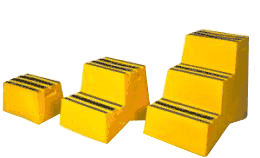
- Materials: Welded steel step frames, slip-resistant tread surfaces, and steel handrail assemblies.
- Step Range: 2-step and 3-step portable industrial step configurations.
- Compliance: Intended for workplace access support where OSHA walking-working surface practices apply.
- Closures/Access Type: Open portable step design with optional bolt-on handrails.
- Product Status: 2-step handrails discontinued; 3-step handrails available where listed.

Product Comparison Chart
| Product | Step Count | Handrails | Mobility | Primary Use |
|---|---|---|---|---|
| Industrial Portable Steps 1-Step Stool | 1 step | Not included | Manual placement | Low-height access for shelves, benches, and equipment areas |
| Industrial Portable Steps 2-Step Stool | 2 steps | 2-step handrails discontinued | Manual placement | Short-reach access for stockrooms, workstations, and maintenance areas |
| Industrial Portable Steps 3-Step Stool | 3 steps | 3-step handrails available where listed | Manual placement | Higher access for shelving, machinery, and warehouse picking |
| Industrial Portable Steps 4-Step Unit with Handrails and Casters | 4 steps | Included | Caster-equipped frame | Mobile access for maintenance, inventory handling, and facility work |
Configuration Analysis
Industrial portable steps are used where fixed ladders, pallet access, dock platforms, or temporary work platforms are not required. A 2-step configuration is generally used for lower access points, such as reaching shelving, machinery panels, or short elevation changes near production equipment. A 3-step configuration provides additional height and is commonly paired with handrails because the user’s center of gravity is raised further from the floor. Handrails serve as an accessory rather than the walking surface itself. They are selected by matching the rail assembly to the step count and frame design of the portable step unit.
Material Engineering
Portable industrial steps are typically built with welded steel frames because steel provides high structural strength, impact resistance, and dimensional stability under repeated workplace use. Tread surfaces may include expanded metal, serrated grating, perforated metal, or applied slip-resistant surfaces depending on the specific step model. These tread designs allow footwear contact while limiting slipping from dust, moisture, or light process residue. Handrail assemblies are generally fabricated from steel tubing or formed steel sections. Painted or powder-coated finishes are used to reduce surface corrosion in indoor industrial environments.
Regulatory Standards
Portable steps and access products should be evaluated against workplace walking-working surface requirements, including OSHA rules related to safe access, fall prevention, surface condition, and employee use. Handrails may be required or recommended depending on step height, use frequency, worksite policy, and risk assessment. Buyers should confirm whether the step unit is being used as a portable step, platform, ladder substitute, or access aid, because each use case can involve different safety requirements. Product compatibility should also be checked before adding or replacing handrail components.
Industrial Applications
Industrial portable steps are used in warehouses, maintenance departments, packaging areas, utility rooms, distribution centers, manufacturing floors, and inventory storage areas. They support access to shelving, control panels, tanks, bins, processing equipment, loading stations, and inspection points. In maintenance settings, portable steps allow workers to reach service panels and equipment components without installing fixed access structures. In warehouse and shipping areas, they are used for carton handling, stock rotation, and reaching materials stored above normal standing height.
Selection Criteria
The main selection factors are step height, tread width, load capacity, handrail compatibility, floor conditions, and storage space. A 2-step unit may be suitable for short-reach tasks, while a 3-step unit may require handrails for added balance and user control. Buyers should confirm that the handrail matches the exact step count and frame style. Discontinued 2-step handrails may require replacement planning, alternate step models, or verification of remaining inventory before purchase. For wet, dusty, or oily environments, tread design and surface grip should be reviewed before use.

