


Drum Racks & Stackers | Industrial Drum Storage Systems
- Material Composition: Carbon Steel, Powder-Coated Steel, Galvanized Steel
- Capacity Range: 1-Drum to 16-Drum Systems (30-Gallon and 55-Gallon)
- Compliance: OSHA Handling Guidelines, EPA Spill Containment (40 CFR 264.175)
- Configurations: Horizontal Racks, Vertical Stackers, Modular Systems, Containment Racks

$399.95
$319.99
$449.99
(You Save 29%)$349.98
$399.99
(You Save 13%)$289.98
$299.99
(You Save 3%)$449.98
$499.99
(You Save 10%)$1,499.98
$1,660.99
(You Save 10%)$1,299.98
$1,499.99
(You Save 13%)$1,999.98
$2,299.99
(You Save 13%)$1,998.96
$2,500.00
(You Save 20%)$44.99$54.99(You Save 18%)
| Buy More, Save More! | ||
|---|---|---|
| Quantity | Price Each | You Save |
| 1 - 1 pieces | $44.99 ea. | $10.00 (18%) |
| 2 - 5 pieces | $42.99 ea. | $12.00 (22%) |
| 6+ pieces | $39.99 ea. | $15.00 (27%) |
$439.98
$518.00
(You Save 15%)$398.98
$470.59
(You Save 15%)
$729.98
$899.98
(You Save 19%)$998.98
$1,200.00
(You Save 17%)$3,298.98
$4,298.98
(You Save 23%)$4,499.88
$5,994.88
(You Save 25%)$2,996.96
$3,596.96
(You Save 17%)$3,698.98
$4,352.00
(You Save 15%)$259.98$306.00(You Save 15%)
| Buy More, Save More! | ||
|---|---|---|
| Quantity | Price Each | You Save |
| 1 - 1 pieces | $259.98 ea. | $46.02 (15%) |
| 2+ pieces | $219.98 ea. | $86.02 (28%) |
$599.95
$349.98
$449.98
(You Save 22%)$229.95
$399.95
$4,499.88
$5,994.88
(You Save 25%)| Product Type | Capacity | Orientation | Material | Containment |
|---|---|---|---|---|
| Welded Drum Rack | 2–3 Drums | Horizontal | Carbon Steel | No |
| Modular Drum Rack System | 1–4 Drums per Unit | Horizontal | Powder-Coated Steel | Optional |
| Convertible Pallet Rack | 12–16 Drums | Mixed | Steel | No |
| Containment Rack System | 6–9 Drums | Mixed | Galvanized Steel | Yes (66–82 Gallon Sump) |
| Drum Stacker | Single Drum | Vertical | Steel | No |
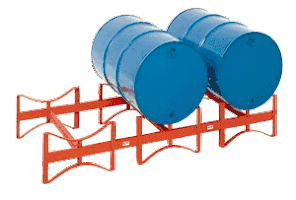
Drum rack and stacker systems are categorized by orientation and function. Horizontal drum racks store drums on their side using cradle supports, enabling controlled dispensing through bung openings. These systems often include roller assemblies to rotate drums during use. Vertical drum stackers are designed for lifting and placing drums upright, typically using hydraulic or forklift-assisted mechanisms. Modular rack systems allow expansion through add-on bays and connector posts, supporting multi-tier storage layouts. Containment rack systems integrate sump basins beneath storage levels to capture leaks, aligning with spill control requirements. Selection of configuration depends on workflow, frequency of access, and dispensing requirements.
Most drum racks and stackers are fabricated from structural carbon steel, selected for load-bearing strength and resistance to deformation under full drum weight. Steel gauge thickness varies based on load rating, with reinforced cross-members and welded joints enhancing structural integrity. Surface treatments include powder coating for abrasion resistance and galvanized finishes for corrosion protection in chemical or outdoor environments. Galvanized steel components, particularly in sump areas, resist chemical exposure and moisture accumulation. Some systems incorporate removable steel grating for drainage and ease of cleaning. Material selection impacts durability, especially in high-cycle industrial use.
Drum storage systems must align with workplace safety and environmental regulations. OSHA guidelines address safe handling and storage practices to reduce injury risk from heavy drum movement. EPA regulations, specifically 40 CFR 264.175, define requirements for secondary containment systems, including sump capacity relative to stored liquid volume. Containment racks with integrated sumps are designed to meet these standards by capturing spills and preventing environmental release. Facilities handling hazardous materials must ensure that rack systems are compatible with UN-rated drums and support compliant storage configurations. Proper equipment selection contributes to regulatory adherence and inspection readiness.
Drum racks and stackers are used across multiple industrial sectors. In chemical processing, they support organized storage and controlled dispensing of solvents and reagents. Manufacturing facilities use these systems to manage lubricants, oils, and raw materials. Warehousing and distribution centers implement multi-tier racks to increase storage density and reduce floor space usage. Recycling operations utilize stackers for safe drum handling and repositioning. Agricultural and food processing environments use corrosion-resistant racks for storing bulk liquids. These systems improve workflow by reducing manual handling and enabling structured inventory management.
Key selection factors include drum size compatibility, load capacity, and storage layout constraints. Systems must support the weight of fully loaded drums, typically up to 800 lbs per drum. Facilities should evaluate whether horizontal dispensing or vertical stacking is required. Environmental exposure influences the need for corrosion-resistant finishes. For hazardous material storage, compatibility with containment systems is critical. Additional considerations include forklift accessibility, modular expansion capability, and available floor space. Matching system configuration to operational workflow improves handling efficiency and reduces risk.
Industrial drum racks and stackers are steel storage systems for 30–55 gallon drums. Main types: horizontal racks (dispensing), vertical stackers (lifting), and containment racks (spill control). Key factors: load capacity, corrosion resistance, and compliance with OSHA/EPA standards.

