


Drum Skids & Tilting Levers | Manual Drum Handling
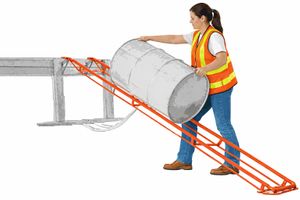
- Material: Carbon Steel, Reinforced Aluminum, Rubber Components
- Capacity: Designed for 30-Gallon and 55-Gallon Drums
- Compliance: OSHA Handling Guidelines Support
- Configurations: Tilting Levers, Upenders, Drum Skids

$129.96
$160.00
(You Save 19%)| Buy More, Save More! | ||
|---|---|---|
| Quantity | Price Each | |
| 1 - 2 pieces | $139.95 ea. | |
| 3+ pieces | $109.44 ea. | |
$499.96
$599.96
(You Save 17%)| Product Type | Material | Drum Size Compatibility | Primary Function | Mobility |
|---|---|---|---|---|
| Drum Tilting Lever | Aluminum / Steel | 30–55 Gallon | Manual drum tipping | Hand-operated |
| Drum Upender | Steel | 30–55 Gallon | Raise drum upright | Hand-operated |
| Drum Skid | Carbon Steel | 30–55 Gallon | Storage and transport base | Forklift compatible |
Drum handling tools in this category are defined by three primary configurations: tilting levers, drum upenders, and drum skids. Tilting levers are long-handle mechanical tools that use leverage to rotate drums from vertical storage to a horizontal dispensing position. Drum upenders perform the inverse function, enabling operators to raise drums from a horizontal resting position to upright orientation. Drum skids are static or semi-mobile platforms designed to support drums during storage or transport. Some skid designs incorporate fork pockets to allow movement via forklift, while others remain fixed for staging applications. These configurations are often used together in facilities requiring manual drum positioning without powered lifting equipment.
Material selection directly impacts load capacity, durability, and environmental resistance. Carbon steel is commonly used for drum skids and upenders due to its high tensile strength and resistance to deformation under full drum loads. Steel components are often powder-coated or galvanized to reduce corrosion exposure in chemical or outdoor environments. Aluminum tilting levers reduce overall weight, allowing easier manual handling while maintaining structural rigidity for controlled leverage. Rubber elements, when integrated, serve as impact buffers and anti-slip surfaces to reduce drum damage and improve operator control. Welded joints and reinforced stress points are critical for maintaining structural integrity under repeated use cycles.
While drum skids and tilting levers are not typically assigned UN ratings, they are used in environments governed by OSHA and DOT safety standards. OSHA guidelines emphasize minimizing manual lifting and controlling heavy object movement to reduce workplace injuries. These tools support compliance by enabling controlled drum repositioning and reducing strain on operators. When used in hazardous material environments, they contribute to spill prevention and safe handling procedures aligned with EPA containment practices. Equipment used alongside UN-rated drums must maintain stability and avoid compromising container integrity during movement.
Drum skids and tilting levers are deployed across multiple industrial sectors handling liquid and semi-liquid materials. In chemical processing facilities, they are used to reposition drums containing solvents, acids, or cleaning agents. Manufacturing plants use these tools for staging raw materials and managing production inputs. Warehouses and distribution centers rely on drum skids for organized storage and efficient forklift transport. Recycling operations use upenders to reposition drums for draining or sorting. These tools are also applied in agricultural operations where bulk liquids such as fertilizers or pesticides are handled in drum formats.
Selection depends on drum size compatibility, load capacity, and operational frequency. Standard tools are designed for 30-gallon and 55-gallon drums, but verification of weight limits is required when handling dense liquids. Material choice should match environmental conditions; steel is preferred for heavy-duty or high-frequency use, while aluminum supports portability. Consider whether the application requires mobility via forklift or fixed positioning for staging. Evaluate handle length and leverage mechanics for operator control when selecting tilting levers. For environments with chemical exposure, corrosion-resistant coatings or finishes should be prioritized.

