


Industrial Drum Scales | Heavy-Duty Platform Weighing
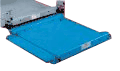
- Material Composition: Powder-Coated Carbon Steel, 304/316 Stainless Steel.
- Capacity Range: 500 lb to 5,000 lb (227 kg to 2,268 kg).
- Compliance/Ratings: NTEP Certified (Legal for Trade), IP65/IP69K, FM Approved.
- Display Types: Digital LCD/LED, Explosion-Proof Indicators, Wireless.

Featured Products
| Product Model | Primary Configuration | Application Environment |
|---|---|---|
| Low Profile Drum Scale | Floor-mounted with integrated ramps | General warehouse and loading docks |
| Self-Powered Drum Scale | Battery-operated, Explosion-Proof (Class I, Div 1) | Hazardous locations and mobile stations |
| Crane-Style Drum Scale | Suspended load cell with drum grabber | Overhead lifting and vertical transport |
Technical Platform Designs Industrial drum scales are categorized by their mechanical interface with the container. Low-profile floor scales feature a height of less than two inches, utilizing integral ramps to facilitate the placement of drums via hand trucks or dollies. This design minimizes the physical effort required for loading and reduces the risk of container tipping. In contrast, crane-style scales utilize a hook-and-grabber mechanism to weigh drums while suspended. This configuration is utilized when floor space is limited or when drums must be weighed during transfer between levels. Self-powered units provide a mobile alternative, incorporating rechargeable battery systems and wheeled frames for point-of-use weighing in large facilities.
Structural Integrity and Coatings The durability of a drum scale is determined by its metallurgical composition and surface treatment. Carbon steel models are typically finished with a structural powder coating to resist abrasion and impact in dry industrial settings. For environments involving moisture, caustic chemicals, or food processing, 304 or 316-grade stainless steel is required. These alloys provide high nickel and chromium content, preventing oxidation and allowing for high-pressure washdown procedures. Load cells—the sensors responsible for weight detection—are often hermetically sealed or "potted" to prevent ingress of dust and liquids, ensuring long-term signal stability and accuracy.
Compliance and Metrological Certification Drum scales used for commercial transactions, where the price is determined by weight, must meet National Type Evaluation Program (NTEP) standards. This certification ensures the device maintains accuracy across a specific temperature range and usage frequency. Furthermore, in environments where volatile vapors or combustible dust are present, scales must be "Explosion-Proof" or "Intrinsically Safe." These units are designed with limited electrical energy to prevent the ignition of hazardous atmospheres, adhering to FM (Factory Mutual) or ATEX standards. Shipping operations also rely on these scales to meet Department of Transportation (DOT) requirements for manifested weight accuracy.
Sector-Specific Utility In the chemical industry, drum scales are used for "loss-in-weight" or "gain-in-weight" batching, where precise amounts of reagents are added to a mixture. The food and beverage sector utilizes stainless steel washdown scales to maintain hygiene standards while measuring bulk ingredients like oils or syrups. In the waste management sector, these scales facilitate the accurate documentation of hazardous waste drums for environmental reporting. Agriculture applications include the measurement of fertilizers and pesticides, where precise dosing is critical for both efficacy and regulatory compliance.
Technical Deployment Factors Selecting an industrial scale requires an analysis of chemical compatibility and the physical storage environment. If the contents of the drum are corrosive, the scale platform and load cells must be composed of materials that will not degrade upon contact. Buyers must also consider "Clearance and Maneuverability"; for instance, a low-profile scale requires sufficient floor space for the ramp and the turning radius of a drum jack. Load capacity should be rated at least 25% higher than the maximum anticipated weight to account for "shock loading"—the sudden force exerted when a drum is dropped onto the platform. Finally, the choice between digital or analog output depends on whether the data must be integrated into an existing Enterprise Resource Planning (ERP) system via RS-232 or Ethernet connections.

