


Little Giant Steel Deck Platform Trucks | Industrial Carts
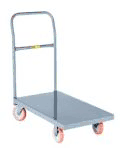
- Material: Heavy-Duty Welded Steel Deck with Steel Frame Construction
- Deck Sizes: 18" x 32", 24" x 36", 24" x 48", and 24" x 60"
- Load Capacities: 1,200 lb and 1,600 lb Models
- Caster Types: Mold-On Rubber and Non-Marking Polyurethane Casters
- Applications: Material Handling, Warehousing, Manufacturing, Distribution, and Maintenance

$299.98
$400.00
(You Save 25%)$299.98
$400.00
(You Save 25%)$299.98
$400.00
(You Save 25%)$299.98
$400.00
(You Save 25%)$299.98
$350.00
(You Save 14%)| Buy More, Save More! | ||
|---|---|---|
| Quantity | Price Each | |
| 1 - 11 pieces | $189.95 ea. | |
| 12+ pieces | $162.91 ea. | |
$299.98
$400.00
(You Save 25%)$399.98
$500.00
(You Save 20%)Product Comparison Chart
Configuration Analysis Steel deck platform trucks are available in multiple deck dimensions and caster configurations to accommodate different material handling requirements. The platform consists of a welded steel deck supported by a reinforced steel frame designed to distribute static and dynamic loads across the chassis during transport. The 18" x 32" models provide a compact footprint for navigating narrow aisles, confined workstations, and storage rooms where maneuverability is prioritized. The 24" x 36" configuration offers additional deck area while maintaining manageable overall dimensions for general warehouse operations.
For transporting larger containers, bulk materials, machinery components, or oversized cartons, the 24" x 48" and 24" x 60" platforms provide increased surface area while maintaining the same heavy-duty steel construction. The longer deck configurations are commonly selected for facilities moving elongated materials, multiple cartons, maintenance equipment, or large shipping containers. Two primary load ratings are available throughout this product family. Mold-on rubber caster models support capacities up to 1,600 pounds, while non-marking polyurethane caster models are rated for 1,200 pounds. Capacity selection should consider both the maximum anticipated load weight and the distribution of that load across the platform surface.
Material Engineering The platform deck is manufactured from welded steel to provide structural rigidity, impact resistance, and dimensional stability under repeated industrial loading cycles. Steel construction minimizes deck deflection when transporting concentrated loads while maintaining overall platform strength during continuous operation. The welded frame transfers load forces throughout the platform rather than concentrating stress at individual connection points. This construction method supports repeated movement of heavy materials throughout manufacturing plants, warehouses, and shipping facilities.
Caster selection directly influences operating characteristics. Mold-on rubber casters utilize a resilient rubber tread bonded to a wheel core. This construction absorbs vibration generated by expansion joints, rough concrete, and minor floor irregularities while reducing shock transmitted to transported materials. Non-marking polyurethane casters utilize a polyurethane tread formulated to minimize floor marking on sealed concrete, epoxy-coated surfaces, finished industrial floors, and commercial facilities. Polyurethane generally provides lower rolling resistance than rubber while maintaining wear resistance during continuous operation.
Regulatory Standards Platform trucks are intended for manual material handling within industrial and commercial facilities. Safe operation should follow applicable workplace material handling procedures and equipment inspection requirements established by facility management. Operators should never exceed the published load capacity of the platform truck. Loads should remain evenly distributed across the steel deck to reduce excessive point loading and maintain directional stability during transport. Facilities operating under OSHA material handling practices should inspect wheels, caster bearings, fasteners, handles, and welded frame components as part of routine equipment maintenance. Damaged casters or structural components should be replaced before continued operation. When transporting materials, operators should maintain clear visibility, avoid abrupt directional changes, and secure unstable loads to minimize shifting during movement.
Industrial Applications Steel deck platform trucks are utilized throughout numerous industries requiring manual transport of heavy materials. Warehousing operations use platform trucks for transporting inventory, cartons, shipping containers, storage totes, and palletized materials that have been broken down into smaller loads. Manufacturing facilities transport machine components, fabricated parts, tooling, maintenance equipment, production materials, and finished assemblies between workstations.
Distribution centers use platform trucks during order fulfillment, inventory replenishment, receiving operations, staging, and shipping preparation. Maintenance departments utilize steel platform trucks for transporting repair equipment, replacement components, portable machinery, lubricants, tools, and maintenance supplies throughout industrial facilities. Commercial institutions, schools, hospitals, laboratories, and municipal facilities also use platform trucks for transporting supplies, equipment, and facility maintenance materials.
Selection Criteria Selecting an appropriate steel deck platform truck requires evaluating several operational factors. Load capacity should exceed the maximum anticipated working load while accounting for dynamic forces encountered during transport. Overloading reduces maneuverability and increases stress on the frame and caster assemblies. Deck dimensions should correspond to the size of the materials being transported while allowing adequate clearance through aisles, doorways, elevators, storage racks, and production areas.
Caster material should be selected according to floor conditions and operating requirements. Mold-on rubber casters provide vibration absorption for rougher floor surfaces, while non-marking polyurethane casters are commonly specified where floor appearance and reduced rolling resistance are important. Facilities should also evaluate transport frequency, travel distance, environmental conditions, storage space, turning radius requirements, and load distribution before selecting the appropriate platform truck configuration.
| Product | Deck Size | Load Capacity | Caster Type | Deck Material |
|---|---|---|---|---|
| Platform Truck | 18" x 32" | 1,600 lb | Mold-On Rubber | Steel |
| Platform Truck | 24" x 36" | 1,600 lb | Mold-On Rubber | Steel |
| Platform Truck | 24" x 48" | 1,600 lb | Mold-On Rubber | Steel |
| Platform Truck | 24" x 60" | 1,600 lb | Mold-On Rubber | Steel |
| Platform Truck | 18" x 32" | 1,200 lb | Non-Marking Polyurethane | Steel |
| Platform Truck | 24" x 36" | 1,200 lb | Non-Marking Polyurethane | Steel |
| Platform Truck | 24" x 48" | 1,200 lb | Non-Marking Polyurethane | Steel |
| Platform Truck | 24" x 60" | 1,200 lb | Non-Marking Polyurethane | Steel |
Configuration Analysis Steel deck platform trucks are available in multiple deck dimensions and caster configurations to accommodate different material handling requirements. The platform consists of a welded steel deck supported by a reinforced steel frame designed to distribute static and dynamic loads across the chassis during transport. The 18" x 32" models provide a compact footprint for navigating narrow aisles, confined workstations, and storage rooms where maneuverability is prioritized. The 24" x 36" configuration offers additional deck area while maintaining manageable overall dimensions for general warehouse operations.
For transporting larger containers, bulk materials, machinery components, or oversized cartons, the 24" x 48" and 24" x 60" platforms provide increased surface area while maintaining the same heavy-duty steel construction. The longer deck configurations are commonly selected for facilities moving elongated materials, multiple cartons, maintenance equipment, or large shipping containers. Two primary load ratings are available throughout this product family. Mold-on rubber caster models support capacities up to 1,600 pounds, while non-marking polyurethane caster models are rated for 1,200 pounds. Capacity selection should consider both the maximum anticipated load weight and the distribution of that load across the platform surface.
Material Engineering The platform deck is manufactured from welded steel to provide structural rigidity, impact resistance, and dimensional stability under repeated industrial loading cycles. Steel construction minimizes deck deflection when transporting concentrated loads while maintaining overall platform strength during continuous operation. The welded frame transfers load forces throughout the platform rather than concentrating stress at individual connection points. This construction method supports repeated movement of heavy materials throughout manufacturing plants, warehouses, and shipping facilities.
Caster selection directly influences operating characteristics. Mold-on rubber casters utilize a resilient rubber tread bonded to a wheel core. This construction absorbs vibration generated by expansion joints, rough concrete, and minor floor irregularities while reducing shock transmitted to transported materials. Non-marking polyurethane casters utilize a polyurethane tread formulated to minimize floor marking on sealed concrete, epoxy-coated surfaces, finished industrial floors, and commercial facilities. Polyurethane generally provides lower rolling resistance than rubber while maintaining wear resistance during continuous operation.
Regulatory Standards Platform trucks are intended for manual material handling within industrial and commercial facilities. Safe operation should follow applicable workplace material handling procedures and equipment inspection requirements established by facility management. Operators should never exceed the published load capacity of the platform truck. Loads should remain evenly distributed across the steel deck to reduce excessive point loading and maintain directional stability during transport. Facilities operating under OSHA material handling practices should inspect wheels, caster bearings, fasteners, handles, and welded frame components as part of routine equipment maintenance. Damaged casters or structural components should be replaced before continued operation. When transporting materials, operators should maintain clear visibility, avoid abrupt directional changes, and secure unstable loads to minimize shifting during movement.
Industrial Applications Steel deck platform trucks are utilized throughout numerous industries requiring manual transport of heavy materials. Warehousing operations use platform trucks for transporting inventory, cartons, shipping containers, storage totes, and palletized materials that have been broken down into smaller loads. Manufacturing facilities transport machine components, fabricated parts, tooling, maintenance equipment, production materials, and finished assemblies between workstations.
Distribution centers use platform trucks during order fulfillment, inventory replenishment, receiving operations, staging, and shipping preparation. Maintenance departments utilize steel platform trucks for transporting repair equipment, replacement components, portable machinery, lubricants, tools, and maintenance supplies throughout industrial facilities. Commercial institutions, schools, hospitals, laboratories, and municipal facilities also use platform trucks for transporting supplies, equipment, and facility maintenance materials.
Selection Criteria Selecting an appropriate steel deck platform truck requires evaluating several operational factors. Load capacity should exceed the maximum anticipated working load while accounting for dynamic forces encountered during transport. Overloading reduces maneuverability and increases stress on the frame and caster assemblies. Deck dimensions should correspond to the size of the materials being transported while allowing adequate clearance through aisles, doorways, elevators, storage racks, and production areas.
Caster material should be selected according to floor conditions and operating requirements. Mold-on rubber casters provide vibration absorption for rougher floor surfaces, while non-marking polyurethane casters are commonly specified where floor appearance and reduced rolling resistance are important. Facilities should also evaluate transport frequency, travel distance, environmental conditions, storage space, turning radius requirements, and load distribution before selecting the appropriate platform truck configuration.

