


Poly-Cade Barriers | Plastic Traffic & Crowd Control Barriers
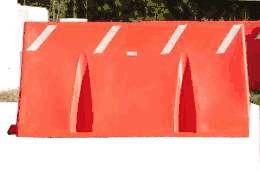
- Material: High-Density Polyethylene (HDPE) Rotationally Molded Construction
- Available Sizes: 60" L x 16" W x 24" H and 72" L x 16" W x 35" H
- Available Colors: Yellow, White, and Orange
- Applications: Traffic Control, Construction Zones, Crowd Management, Parking Areas, and Worksite Safety
- Configuration: Interlocking Portable Polyethylene Barrier Design

Product Comparison Chart
Configuration Analysis Poly-Cade barriers utilize an interlocking modular configuration that allows individual sections to connect together, forming continuous traffic control systems. The molded connection points enable rapid installation and removal without specialized equipment. Individual barriers can be deployed as standalone units for localized hazard marking or linked together to create longer pedestrian walkways, lane separations, construction boundaries, or equipment exclusion zones. The 60-inch models provide a compact solution for smaller work areas, indoor facilities, warehouse traffic control, and temporary maintenance projects. The larger 72-inch models offer increased visibility and extended coverage for road construction, parking facilities, utility work, municipal projects, and larger event management applications. Both configurations maintain the same 16-inch width while differing in overall height to meet varying visibility and containment requirements.
Material Engineering Poly-Cade barriers are manufactured using rotational molding technology with high-density polyethylene (HDPE). This manufacturing process produces a one-piece seamless structure with consistent wall thickness throughout the barrier body. HDPE provides impact resistance while maintaining flexibility under varying environmental conditions. Unlike steel barriers, polyethylene construction eliminates corrosion concerns caused by moisture, chemicals, road salt, and outdoor exposure. The UV-stabilized material helps reduce degradation from prolonged sunlight exposure, making these barriers suitable for long-term outdoor installations. The molded construction also minimizes maintenance requirements since the material does not require painting or protective coatings. The lightweight characteristics of HDPE improve handling efficiency during transportation and deployment while maintaining sufficient structural integrity for traffic guidance and worksite separation.
Traffic Safety Applications Poly-Cade barriers are used across transportation, municipal, industrial, commercial, and construction environments where temporary or movable barriers are required. Construction contractors utilize them to separate active work zones from pedestrian and vehicle traffic. Municipal agencies deploy them for road maintenance, utility repairs, and emergency response operations. Parking facilities use polyethylene barriers for directing vehicle flow, blocking restricted areas, and organizing temporary traffic patterns. Event organizers utilize connected barrier systems for crowd control, queue management, and pedestrian routing. Industrial facilities install portable barriers to isolate maintenance activities, equipment movement areas, and warehouse traffic lanes. Color selection may support project visibility requirements or organizational standards, with yellow, orange, and white commonly used for different traffic management applications.
Regulatory Considerations Traffic control barriers should be selected according to local, state, and federal traffic safety requirements where applicable. Municipal projects frequently reference guidelines established for temporary traffic control devices to determine barrier placement, spacing, visibility, and application. Additional reflective sheeting, warning lights, signage, or barricade panels may be installed when required for roadway projects, nighttime visibility, or work zone compliance. Users should verify project-specific specifications before selecting barrier configurations for public roadway applications.
Selection Criteria Selecting the appropriate Poly-Cade barrier depends on installation environment, required visibility, deployment length, and anticipated traffic conditions. Larger 72-inch barriers provide increased visual presence for roadways and larger outdoor work zones, while 60-inch models are commonly selected for warehouses, parking structures, indoor facilities, and compact construction areas. Environmental exposure should also be considered when selecting barrier materials. Polyethylene construction provides resistance to rust, moisture, and many environmental contaminants, making it suitable for long-term outdoor storage and repeated deployment. Buyers should evaluate required barrier quantity, overall project length, color requirements, transportation methods, and storage space before determining the appropriate configuration.
| Product | Dimensions (L × W × H) | Color | Material | Configuration | Primary Applications |
|---|---|---|---|---|---|
| Poly-Cade Barrier | 60" × 16" × 24" | Yellow | High-Density Polyethylene (HDPE) | Interlocking Portable Barrier | Traffic Control, Warehouses, Parking Areas |
| Poly-Cade Barrier | 60" × 16" × 24" | White | High-Density Polyethylene (HDPE) | Interlocking Portable Barrier | Crowd Control, Facility Management, Construction |
| Poly-Cade Barrier | 60" × 16" × 24" | Orange | High-Density Polyethylene (HDPE) | Interlocking Portable Barrier | Construction Zones, Road Work, Traffic Guidance |
| Poly-Cade Barrier | 72" × 16" × 35" | Yellow | High-Density Polyethylene (HDPE) | Interlocking Portable Barrier | Roadways, Utility Projects, Municipal Work |
| Poly-Cade Barrier | 72" × 16" × 35" | White | High-Density Polyethylene (HDPE) | Interlocking Portable Barrier | Pedestrian Routing, Event Management, Parking Control |
| Poly-Cade Barrier | 72" × 16" × 35" | Orange | High-Density Polyethylene (HDPE) | Interlocking Portable Barrier | Construction Sites, Traffic Separation, Public Safety |
Configuration Analysis Poly-Cade barriers utilize an interlocking modular configuration that allows individual sections to connect together, forming continuous traffic control systems. The molded connection points enable rapid installation and removal without specialized equipment. Individual barriers can be deployed as standalone units for localized hazard marking or linked together to create longer pedestrian walkways, lane separations, construction boundaries, or equipment exclusion zones. The 60-inch models provide a compact solution for smaller work areas, indoor facilities, warehouse traffic control, and temporary maintenance projects. The larger 72-inch models offer increased visibility and extended coverage for road construction, parking facilities, utility work, municipal projects, and larger event management applications. Both configurations maintain the same 16-inch width while differing in overall height to meet varying visibility and containment requirements.
Material Engineering Poly-Cade barriers are manufactured using rotational molding technology with high-density polyethylene (HDPE). This manufacturing process produces a one-piece seamless structure with consistent wall thickness throughout the barrier body. HDPE provides impact resistance while maintaining flexibility under varying environmental conditions. Unlike steel barriers, polyethylene construction eliminates corrosion concerns caused by moisture, chemicals, road salt, and outdoor exposure. The UV-stabilized material helps reduce degradation from prolonged sunlight exposure, making these barriers suitable for long-term outdoor installations. The molded construction also minimizes maintenance requirements since the material does not require painting or protective coatings. The lightweight characteristics of HDPE improve handling efficiency during transportation and deployment while maintaining sufficient structural integrity for traffic guidance and worksite separation.
Traffic Safety Applications Poly-Cade barriers are used across transportation, municipal, industrial, commercial, and construction environments where temporary or movable barriers are required. Construction contractors utilize them to separate active work zones from pedestrian and vehicle traffic. Municipal agencies deploy them for road maintenance, utility repairs, and emergency response operations. Parking facilities use polyethylene barriers for directing vehicle flow, blocking restricted areas, and organizing temporary traffic patterns. Event organizers utilize connected barrier systems for crowd control, queue management, and pedestrian routing. Industrial facilities install portable barriers to isolate maintenance activities, equipment movement areas, and warehouse traffic lanes. Color selection may support project visibility requirements or organizational standards, with yellow, orange, and white commonly used for different traffic management applications.
Regulatory Considerations Traffic control barriers should be selected according to local, state, and federal traffic safety requirements where applicable. Municipal projects frequently reference guidelines established for temporary traffic control devices to determine barrier placement, spacing, visibility, and application. Additional reflective sheeting, warning lights, signage, or barricade panels may be installed when required for roadway projects, nighttime visibility, or work zone compliance. Users should verify project-specific specifications before selecting barrier configurations for public roadway applications.
Selection Criteria Selecting the appropriate Poly-Cade barrier depends on installation environment, required visibility, deployment length, and anticipated traffic conditions. Larger 72-inch barriers provide increased visual presence for roadways and larger outdoor work zones, while 60-inch models are commonly selected for warehouses, parking structures, indoor facilities, and compact construction areas. Environmental exposure should also be considered when selecting barrier materials. Polyethylene construction provides resistance to rust, moisture, and many environmental contaminants, making it suitable for long-term outdoor storage and repeated deployment. Buyers should evaluate required barrier quantity, overall project length, color requirements, transportation methods, and storage space before determining the appropriate configuration.

