


Beckson Drum Pumps for Chemicals & Petroleum
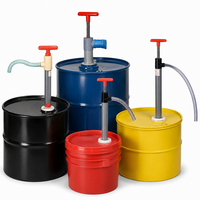
- Material Composition: PVC, steel components, chemical-compatible seals, and food-grade pump configurations.
- Size/Capacity Range: Drum and pail pumps with 3 ft and 6 ft hose options; selected models deliver up to 28 oz per stroke.
- Compliance/Ratings: Chemical-transfer, petroleum-transfer, sanitary, and food-grade application options; compatibility must be verified for the specific liquid.
- Closure Types: 2 in NPS, 2 in buttress, 3/4 in NPS, 61 mm, and 70 mm container-opening adapters.
- Pump Configurations: Acid, alkali, petroleum, sanitary maintenance, food-grade, siphon/stroke, and pail pump designs.

$229.96
$259.00
(You Save 11%)$199.96
$239.98
(You Save 17%)$229.96
$300.00
(You Save 23%)$189.96
$200.00
(You Save 5%)$239.96
$269.98
(You Save 11%)$229.96
$259.98
(You Save 12%)$249.96
$300.00
(You Save 17%)$189.96
$210.00
(You Save 10%)$129.96
$165.00
(You Save 21%)$139.96
$170.00
(You Save 18%)
$9.96
$14.96
(You Save 33%)$119.96
$114.96
(You Save -4%)$129.96
$139.96
(You Save 7%)$179.96
$199.96
(You Save 10%)$119.96
$129.96
(You Save 8%)$99.96
$109.96
(You Save 9%)$99.96
$139.98
(You Save 29%)$49.96
$59.96
(You Save 17%)$89.96
$99.96
(You Save 10%)$179.96
$209.98
(You Save 14%)$199.96
$210.96
(You Save 5%)
Product Comparison Chart
Configuration Analysis Beckson pumps are configured around the fluid being transferred, the container opening, and the required discharge arrangement. Acid stroke pumps are intended for compatible acidic solutions, while alkali models are configured for alkaline chemicals. Petroleum stroke pumps are designed for compatible oils, fuels, lubricants, and related hydrocarbon-based fluids. Several full-size drum models use either a 2-inch NPS threaded adapter or a 2-inch buttress adapter, allowing the pump to match different drum bung designs. Hose-equipped models are available with 3-foot or 6-foot discharge hoses. The category also includes food-grade hand pumps with non-drip or clear-hose discharge configurations, sanitary maintenance pumps rated at 8 ounces per stroke, and siphon/stroke models rated at approximately 11 ounces per stroke. Pail pumps extend the same manual-transfer concept to smaller containers with 3/4-inch NPS, 2-inch NPS, 61 mm, and 70 mm openings.
Material Engineering PVC is a primary wetted material across many Beckson chemical-transfer pumps because it provides resistance to a broad range of corrosive aqueous chemicals. Steel is incorporated into selected stroke-pump assemblies where additional structural support is required. Because chemical resistance varies according to concentration, temperature, fluid composition, seal material, and exposure duration, PVC construction alone does not establish universal compatibility. Acid, alkali, petroleum, and food-contact liquids can place different demands on pump tubes, seals, valves, hoses, and fittings. Buyers should confirm compatibility for every wetted component before use. Hose diameter also affects transfer characteristics; several listed stroke pumps use 1-1/4-inch hose assemblies, while selected models are approximately 1-1/2 inches in body diameter and 38 inches long. Non-drip spouts and flexible discharge assemblies can further control the discharge path.
Regulatory Standards and Transfer Safety Manual drum pumps are transfer devices and should not be assumed to provide a UN packaging certification by themselves. UN performance ratings generally apply to complete hazardous-material packaging systems rather than the dispensing pump installed after storage or shipment. When hazardous chemicals or petroleum products are transferred, the container, pump materials, operating procedure, labeling, employee protection, and spill controls should be evaluated against applicable DOT and OSHA requirements. Pump selection should also account for the liquid's safety data sheet, flash point, corrosivity, vapor characteristics, and grounding or bonding requirements where static ignition is a concern. Food-grade or sanitary models should be reserved for compatible sanitary processes and maintained according to the facility's cleaning and contamination-control procedures.
Industrial Applications Acid and alkali stroke pumps are used in chemical processing, metal treatment, maintenance departments, water-treatment operations, and manufacturing facilities that dispense corrosive liquids from drums. Petroleum models support transfer of compatible lubricants, oils, fuels, and maintenance fluids in automotive, equipment-service, industrial, and agricultural environments. Food-grade hand pumps can be used for compatible consumable or sanitary liquids where controlled manual dispensing is required. Sanitary maintenance pumps support cleaning and process-maintenance applications, while pail pumps are suited to lower-volume containers used for chemicals, cleaners, lubricants, coatings, and production fluids. High-output stroke pumps delivering up to 28 ounces per cycle can reduce the number of manual strokes required when transferring larger fluid quantities.
Selection Criteria Pump selection should begin with chemical compatibility rather than flow rate alone. Confirm whether the fluid is acidic, alkaline, petroleum-based, food-contact, solvent-containing, viscous, or otherwise chemically aggressive. Match the pump's wetted PVC, steel, seal, and hose materials to the specific product being dispensed. Next, verify the container closure: 2-inch NPS and 2-inch buttress fittings are not interchangeable, and smaller pails may require 3/4-inch NPS, 61 mm, or 70 mm adapters. Determine the required discharge reach before selecting a 3-foot or 6-foot hose. Output per stroke should be considered for throughput planning, with listed models ranging from approximately 8 ounces to 28 ounces per stroke. Non-drip spouts, Flexspout assemblies, and strap-lock accessories may be appropriate where drip control, dispensing direction, or
| Product | Application | Adapter | Hose / Spout | Output / Configuration |
|---|---|---|---|---|
| Beckson Acid Stroke Pump | Acid transfer | 2 in NPS | 3 ft hose | PVC/steel stroke pump |
| Beckson Alkali Stroke Pump | Alkali transfer | 2 in Buttress | 3 ft hose | Manual stroke pump |
| Beckson Acid Stroke Pump | Acid transfer | 2 in Buttress | 6 ft hose | Up to 28 oz per stroke |
| Beckson Petroleum Stroke Pump | Petroleum liquids | 2 in NPS | 3 ft or 6 ft hose | PVC/steel construction; selected model 28 oz per stroke |
| Beckson Acid Transfer Enviropump | Chemical / acid transfer | 2 in NPS | Direct-transfer configuration | Manual chemical drum pump |
| Beckson Food Grade Hand Drum Pump | Food-grade liquids | Drum configuration | Non-drip spout | Sanitary dispensing configuration |
| Beckson Food Grade Hand Drum Pump | Food-grade liquids | Drum configuration | 9 in clear hose | Manual sanitary transfer |
| Beckson Sanitary Maintenance Pump | Sanitary / maintenance liquids | 2 in NPS | Standard discharge | 8 oz per stroke |
| Beckson Siphon/Stroke Drum Pump | General liquid transfer | Drum-mounted | Stroke / siphon configuration | 11 oz per stroke |
| Beckson PVC Pail Pump | Pail and small-container transfer | 3/4 in NPS or 2 in NPS | Standard or Flexspout | Manual PVC pump |
| Beckson PVC Pail Pump | Pail and small-container transfer | 61 mm or 70 mm opening | Standard or no-drip spout | Manual PVC pump |
Configuration Analysis Beckson pumps are configured around the fluid being transferred, the container opening, and the required discharge arrangement. Acid stroke pumps are intended for compatible acidic solutions, while alkali models are configured for alkaline chemicals. Petroleum stroke pumps are designed for compatible oils, fuels, lubricants, and related hydrocarbon-based fluids. Several full-size drum models use either a 2-inch NPS threaded adapter or a 2-inch buttress adapter, allowing the pump to match different drum bung designs. Hose-equipped models are available with 3-foot or 6-foot discharge hoses. The category also includes food-grade hand pumps with non-drip or clear-hose discharge configurations, sanitary maintenance pumps rated at 8 ounces per stroke, and siphon/stroke models rated at approximately 11 ounces per stroke. Pail pumps extend the same manual-transfer concept to smaller containers with 3/4-inch NPS, 2-inch NPS, 61 mm, and 70 mm openings.
Material Engineering PVC is a primary wetted material across many Beckson chemical-transfer pumps because it provides resistance to a broad range of corrosive aqueous chemicals. Steel is incorporated into selected stroke-pump assemblies where additional structural support is required. Because chemical resistance varies according to concentration, temperature, fluid composition, seal material, and exposure duration, PVC construction alone does not establish universal compatibility. Acid, alkali, petroleum, and food-contact liquids can place different demands on pump tubes, seals, valves, hoses, and fittings. Buyers should confirm compatibility for every wetted component before use. Hose diameter also affects transfer characteristics; several listed stroke pumps use 1-1/4-inch hose assemblies, while selected models are approximately 1-1/2 inches in body diameter and 38 inches long. Non-drip spouts and flexible discharge assemblies can further control the discharge path.
Regulatory Standards and Transfer Safety Manual drum pumps are transfer devices and should not be assumed to provide a UN packaging certification by themselves. UN performance ratings generally apply to complete hazardous-material packaging systems rather than the dispensing pump installed after storage or shipment. When hazardous chemicals or petroleum products are transferred, the container, pump materials, operating procedure, labeling, employee protection, and spill controls should be evaluated against applicable DOT and OSHA requirements. Pump selection should also account for the liquid's safety data sheet, flash point, corrosivity, vapor characteristics, and grounding or bonding requirements where static ignition is a concern. Food-grade or sanitary models should be reserved for compatible sanitary processes and maintained according to the facility's cleaning and contamination-control procedures.
Industrial Applications Acid and alkali stroke pumps are used in chemical processing, metal treatment, maintenance departments, water-treatment operations, and manufacturing facilities that dispense corrosive liquids from drums. Petroleum models support transfer of compatible lubricants, oils, fuels, and maintenance fluids in automotive, equipment-service, industrial, and agricultural environments. Food-grade hand pumps can be used for compatible consumable or sanitary liquids where controlled manual dispensing is required. Sanitary maintenance pumps support cleaning and process-maintenance applications, while pail pumps are suited to lower-volume containers used for chemicals, cleaners, lubricants, coatings, and production fluids. High-output stroke pumps delivering up to 28 ounces per cycle can reduce the number of manual strokes required when transferring larger fluid quantities.
Selection Criteria Pump selection should begin with chemical compatibility rather than flow rate alone. Confirm whether the fluid is acidic, alkaline, petroleum-based, food-contact, solvent-containing, viscous, or otherwise chemically aggressive. Match the pump's wetted PVC, steel, seal, and hose materials to the specific product being dispensed. Next, verify the container closure: 2-inch NPS and 2-inch buttress fittings are not interchangeable, and smaller pails may require 3/4-inch NPS, 61 mm, or 70 mm adapters. Determine the required discharge reach before selecting a 3-foot or 6-foot hose. Output per stroke should be considered for throughput planning, with listed models ranging from approximately 8 ounces to 28 ounces per stroke. Non-drip spouts, Flexspout assemblies, and strap-lock accessories may be appropriate where drip control, dispensing direction, or

