


Zee Line Oil Dispensing Meters & Fluid Nozzle
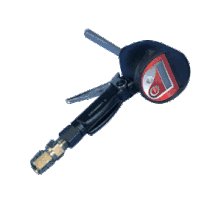
- Material Composition: Aluminum housings, reinforced rubber nozzles, and nitrile/Viton seals.
- Measurement Range: Flow rates up to 8 GPM; scales in Quarts, Gallons, and Liters.
- Compliance/Ratings: Calibrated for motor oils, gear oils, and ATF; weather-resistant digital displays.
- Configuration Types: Manual and Automatic shut-off; flexible and rigid nozzle extensions.

$333.98
$409.98
(You Save 19%)| Product Model | Dispenser Type | Measurement Unit | Nozzle Type |
|---|---|---|---|
| Digital Meter with Handle & Flex Nozzle | Manual Digital | Multi-Unit Digital | Flexible |
| Tough, Accurate, Electronic Metered Nozzle | Heavy-Duty Digital | Electronic Digital | Rigid/Flex Hybrid |
| Automatic Motor Oil Dispenser Meter | Automatic | US Quarts to Gallons | Automatic Shut-off |
| Automatic Dispenser And Meter For Motor Oils | Automatic | Standard Units | Rigid Extension |
| Automatic Dispenser And Meter - Liter Meter | Automatic | Metric (Liters) | Rigid Extension |
Metering and Nozzle Architectures Industrial fluid dispensers are categorized by their control interface and measurement mechanism. Manual metered nozzles require the operator to maintain trigger pressure throughout the fluid transfer, providing immediate tactile control over flow. Automatic dispensers utilize internal shut-off valves that trigger when the receiving vessel reaches capacity or a pre-set volume is achieved. Digital meters employ nutating disc or oval gear technology to track fluid volume, translating mechanical movement into electronic data shown on an LCD. Mechanical totalizers use gear-driven analog registers, which are often preferred in environments where battery maintenance is impractical or where extreme temperatures may affect digital displays.
Component Durability and Fluid Compatibility The chassis of Zee Line meters is typically constructed from die-cast aluminum or impact-resistant polymers to balance weight and structural integrity. Internal seals are fabricated from nitrile (Buna-N) or Viton to ensure compatibility with petroleum-based products, preventing degradation and leaks. Nozzle extensions are offered in two primary formats: flexible hose extensions, which facilitate access to recessed or obstructed fill points, and rigid steel extensions, which provide stability for high-pressure dispensing. The integration of swivel inlets at the handle base prevents hose kinking and reduces mechanical stress on the connection points during high-volume operations.
Calibration and Industry Compliance Precision in fluid dispensing is governed by internal calibration standards to ensure that the volume displayed matches the volume discharged. Most industrial meters allow for field calibration to account for variations in fluid viscosity and temperature, which can impact volumetric expansion. While these meters are designed for industrial and automotive service use, they are typically non-commercial (not "Legal for Trade") unless specifically certified by Weights and Measures authorities. However, they meet standard industrial safety requirements for the handling of non-volatile lubricants and are rated for specific pressure thresholds, often exceeding 1,000 PSI, to accommodate high-pressure grease and oil pump systems.
Sector-Specific Deployment Oil dispensing meters are essential in automotive service centers, heavy equipment maintenance facilities, and industrial manufacturing plants. In automotive settings, they are used to fill crankcases and transmissions with exact manufacturer-specified volumes to avoid overfill conditions. In agricultural and construction sectors, portable metered nozzles are attached to mobile lube skids for field servicing of machinery. Production environments utilize these tools for the precise filling of reservoirs in hydraulic systems and stationary gearboxes, where maintaining fluid levels is critical to mechanical longevity and operational uptime.
Technical Factors for Implementation Selecting an appropriate dispensing meter requires an evaluation of fluid viscosity, required flow rate, and environmental conditions. The viscosity of the lubricant (e.g., 10W30 vs. 85W140 gear oil) dictates whether a standard digital meter or a heavy-duty mechanical unit is required, as higher viscosities increase backpressure. Flow rate capacity must align with the pump's output to prevent restriction or damage to the meter’s internal gears. Additionally, buyers must consider the units of measure required for their specific application—liters, quarts, or gallons—and whether the environment necessitates a backlit digital interface for low-light visibility or a mechanical counter for extreme temperature fluctuations.

