


Seamless Tins with Clear Windows | Metal Containers
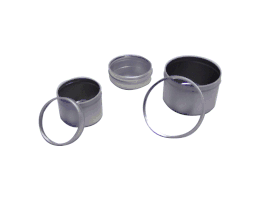
- Materials: Seamless tinplate steel bottoms with clear plastic window lids.
- Capacities: 2 oz. flat tins, 4 oz. deep tins, and 8 oz. deep tins.
- Dimensions: 4 oz. components include 60 mm crystal clear lids and tin bottoms.
- Compliance: No UN rating specified; verify suitability for food, cosmetic, craft, or sample use.
- Closures: Clear window covers and friction-fit crystal clear lids.

Product Comparison Chart
Flat and Deep Tin Formats Seamless tins in this section are divided into flat and deep configurations. The 2 oz. flat seamless tin is suited for shallow contents, including wax samples, balms, small hardware, dry goods, and compact promotional items. The 4 oz. and 8 oz. deep tin bottoms provide increased vertical capacity for products requiring greater fill depth. Separate lid and bottom listings indicate component-based packaging, where the lid and base may be ordered in matching case quantities for assembly workflows.
Clear Window and Crystal Clear Lid Design Clear window covers and crystal clear lids provide visual access to the packaged contents. This configuration is used when product identification, color visibility, or fill-level inspection is required without removing the closure. Friction-fit closures rely on dimensional contact between the lid and tin body rather than threaded or hinged hardware. This format supports manual filling, batch packing, and lightweight retail or industrial packaging applications.
Seamless Tinplate Construction Seamless tin bottoms are typically formed from tinplate steel using drawing and forming processes that create a continuous container body without a welded side seam. This reduces sidewall discontinuities and creates a uniform exterior surface for labeling or decoration. Tinplate provides a metal barrier structure suitable for dry contents and many non-reactive semi-solid products. Interior compatibility should be evaluated when packaging water-based, acidic, alkaline, or solvent-containing materials.
Clear Plastic Lid Components The clear lid or window component is generally used to provide visibility while maintaining a closed package profile. Plastic lid compatibility should be reviewed against fragrance oils, essential oils, solvents, and other volatile ingredients, as these materials may affect clarity, fit, or dimensional stability. For production use, buyers should confirm lid diameter, tin depth, closure tolerance, and stacking behavior under filled conditions.
Packaging Compliance Considerations No UN hazardous materials rating is specified for these seamless tins. They should not be assumed to meet DOT hazardous materials packaging requirements without documented testing and certification. For food, cosmetic, pharmaceutical, or personal care packaging, buyers should confirm material declarations, migration compliance, coating details, and supplier documentation. Labeling requirements may also apply based on the packaged substance, net weight, ingredient disclosure, and distribution channel.
Common Use Cases Seamless tins with clear windows are used in cosmetics, candle sampling, confectionery packaging, craft storage, laboratory sampling, hardware kitting, and promotional packaging. Flat 2 oz. tins support compact units, while 4 oz. and 8 oz. deep tin bottoms accommodate larger volumes or thicker contents. Clear lids assist with visual sorting in fulfillment, production staging, and retail display environments where identifying contents without opening the package reduces handling.
Technical Buying Factors Selection should be based on fill volume, product chemistry, closure fit, lid diameter, case-pack quantity, and handling method. The 60 mm dimension on the 4 oz. lid and bottom should be matched before ordering components. Packaging engineers should also evaluate whether the contents require tamper evidence, liners, labeling surface area, moisture control, or secondary cartons. For automated or semi-automated filling, dimensional consistency, nesting behavior, and lid application force should be reviewed before full production use.
| Product | Capacity / Size | Component Type | Material / Feature | Case Pack |
|---|---|---|---|---|
| Flat Seamless Tin with Clear Window Cover | 2 oz. | Complete tin with cover | Seamless tin body with clear window cover | 2,592 pack case |
| Crystal Clear Lid | 4 oz. / 60 mm | Lid only | Crystal clear plastic lid | 3,456 case pack |
| Deep Tin Bottom | 4 oz. / 60 mm | Bottom only | Deep seamless tin bottom | 2,880 case pack |
| Crystal Clear Lid | 8 oz. | Lid only | Crystal clear plastic lid | 2,880 pack case |
| Deep Tin Bottom | 8 oz. | Bottom only | Deep seamless tin bottom | 2,592 minimum case pack |
Flat and Deep Tin Formats Seamless tins in this section are divided into flat and deep configurations. The 2 oz. flat seamless tin is suited for shallow contents, including wax samples, balms, small hardware, dry goods, and compact promotional items. The 4 oz. and 8 oz. deep tin bottoms provide increased vertical capacity for products requiring greater fill depth. Separate lid and bottom listings indicate component-based packaging, where the lid and base may be ordered in matching case quantities for assembly workflows.
Clear Window and Crystal Clear Lid Design Clear window covers and crystal clear lids provide visual access to the packaged contents. This configuration is used when product identification, color visibility, or fill-level inspection is required without removing the closure. Friction-fit closures rely on dimensional contact between the lid and tin body rather than threaded or hinged hardware. This format supports manual filling, batch packing, and lightweight retail or industrial packaging applications.
Seamless Tinplate Construction Seamless tin bottoms are typically formed from tinplate steel using drawing and forming processes that create a continuous container body without a welded side seam. This reduces sidewall discontinuities and creates a uniform exterior surface for labeling or decoration. Tinplate provides a metal barrier structure suitable for dry contents and many non-reactive semi-solid products. Interior compatibility should be evaluated when packaging water-based, acidic, alkaline, or solvent-containing materials.
Clear Plastic Lid Components The clear lid or window component is generally used to provide visibility while maintaining a closed package profile. Plastic lid compatibility should be reviewed against fragrance oils, essential oils, solvents, and other volatile ingredients, as these materials may affect clarity, fit, or dimensional stability. For production use, buyers should confirm lid diameter, tin depth, closure tolerance, and stacking behavior under filled conditions.
Packaging Compliance Considerations No UN hazardous materials rating is specified for these seamless tins. They should not be assumed to meet DOT hazardous materials packaging requirements without documented testing and certification. For food, cosmetic, pharmaceutical, or personal care packaging, buyers should confirm material declarations, migration compliance, coating details, and supplier documentation. Labeling requirements may also apply based on the packaged substance, net weight, ingredient disclosure, and distribution channel.
Common Use Cases Seamless tins with clear windows are used in cosmetics, candle sampling, confectionery packaging, craft storage, laboratory sampling, hardware kitting, and promotional packaging. Flat 2 oz. tins support compact units, while 4 oz. and 8 oz. deep tin bottoms accommodate larger volumes or thicker contents. Clear lids assist with visual sorting in fulfillment, production staging, and retail display environments where identifying contents without opening the package reduces handling.
Technical Buying Factors Selection should be based on fill volume, product chemistry, closure fit, lid diameter, case-pack quantity, and handling method. The 60 mm dimension on the 4 oz. lid and bottom should be matched before ordering components. Packaging engineers should also evaluate whether the contents require tamper evidence, liners, labeling surface area, moisture control, or secondary cartons. For automated or semi-automated filling, dimensional consistency, nesting behavior, and lid application force should be reviewed before full production use.

