


Justrite Corrosive Safety Storage Cabinets | Steel & Poly
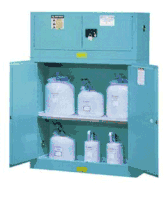
- Material Composition: 18-Gauge Double-Wall Steel, High-Density Polyethylene, and Non-Metallic variants.
- Size/Capacity Range: 4-Gallon to 60-Gallon capacities; specialized 2.5-liter and 4-liter bottle storage.
- Compliance/Ratings: OSHA 29 CFR 1910.106 and NFPA Code 30 compliant; FM Approved.
- Closure Types: Manual Close 1-door and 2-door, Self-Close 2-door, and Sliding door configurations.

| Product Description | Capacity | Door Configuration | Material |
|---|---|---|---|
| Justrite Corrosive Safety Storage Cabinet | 4 gal. | 1-door | Steel |
| Justrite Corrosive Safety Storage Cabinet | 12 gal. | 2-door | Steel |
| Justrite Corrosive Safety Storage Cabinet | 17 gal. | 2-door | Steel |
| Justrite Corrosive Safety Storage Cabinet | 22 gal. | 2-door | Steel |
| Justrite Corrosive Safety Storage Cabinet | 30 gal. | 2-door | Steel |
| Justrite Corrosive Safety Storage Cabinet | 30 gal. | Sliding | Steel |
| Justrite Corrosive Safety Storage Cabinet | 45 gal. | 2-door | Steel |
| Justrite Corrosive Safety Storage Cabinet | 60 gal. | 2-door | Steel |
| Non-Metallic Corrosive Cabinet (6 Bottles) | 15 liters | Manual | Non-Metallic |
| Non-Metallic Corrosive Cabinet (36 Bottles) | 90 liters | Manual | Non-Metallic |
| All-Polyethylene Corrosive Cabinet | 30 liters | Manual | Polyethylene |
Door and Access Configurations Corrosive safety cabinets are categorized by their door mechanisms: manual-close, self-close, and sliding. Manual-close doors open to a full 180 degrees and require the operator to physically shut the unit. Self-close models feature a specialized linkage that automatically closes and latches the doors when temperatures reach a specific threshold, or when the door is released, providing an extra layer of fire protection. Sliding door configurations are utilized in high-traffic or narrow-aisle environments where swinging doors would obstruct pathways. Internal shelving is adjustable on 3-inch (76-mm) centers to accommodate varying bottle heights and maximize vertical storage space.
Substrate Protection and Chemical Resistance The engineering of these cabinets focuses on preventing structural failure due to oxidation or chemical reaction. Steel cabinets are constructed with double-wall 18-gauge (1-mm) thickness and a 1.5-inch (38-mm) insulating air space. The steel is treated with a specialized chemically resistant powder-coat finish. For high-purity or highly aggressive acids, such as hydrochloric or nitric acid, non-metallic and all-polyethylene models are used. These units contain no metal parts that could corrode. Additionally, many steel units include polyethylene shelf trays and bottom liners to act as a secondary barrier, preventing spills from making direct contact with the steel sump.
Compliance with OSHA and NFPA Protocols All Justrite corrosive cabinets are designed to meet the technical requirements of OSHA 29 CFR 1910.106 and NFPA Code 30. These regulations mandate specific spill-containment capacities, typically requiring a 2-inch (51-mm) leakproof sump at the base to hold accidental releases. Units often carry FM (Factory Mutual) Approval, indicating they have undergone rigorous testing for structural integrity and fire resistance. To comply with environmental health and safety (EHS) protocols, these cabinets include dual vents with flame arresters and a grounding connector to dissipate static electricity, although grounding is primarily prioritized when flammable vapors are also present.
Sector-Specific Deployment The application of corrosive storage extends across chemical processing, wastewater treatment, and laboratory research. In chemical manufacturing, large-capacity 60-gallon steel cabinets store bulk reagents used in production. Laboratory environments frequently utilize under-counter or countertop non-metallic units for the storage of 2.5-liter glass bottles of concentrated acids. Agricultural facilities use these cabinets to secure liquid fertilizers and pesticides that possess corrosive properties. The variety of materials ensures that whether the environment is a high-temperature manufacturing floor or a moisture-rich water treatment plant, the cabinet maintains its physical properties.
Technical Factors for Procurement Selecting the appropriate cabinet requires an analysis of chemical compatibility and volume. Buyers must distinguish between "corrosive" and "flammable" hazards, though many corrosive cabinets are also designed to handle flammable corrosives. The choice between steel and polyethylene is determined by the pH level and volatility of the stored substances; for example, high-concentration mineral acids typically necessitate all-polyethylene construction to prevent long-term structural degradation. Capacity should be selected based on the maximum volume of chemicals allowed on-site by local fire codes, ensuring that the sump capacity remains sufficient for the largest single container stored within the unit.

