


Industrial Drum Wrenches & Plug Tools | Metal & Bronze
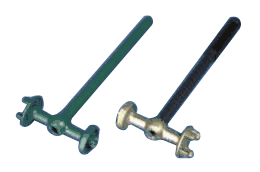
- Material Composition: Cast Iron, Spark-Resistant,Bronze.
- Plug Compatibility: Standard 2" and 3/4" Hex-Head and Round-Head Bung Plugs.
- Safety Ratings: Sparkless options for OSHA-regulated hazardous environments.
- Tool Types: Socket-Head, Prong-Style, and Universal Multi-Tool Configurations.

$109.96
$149.96
(You Save 27%)$229.98$179.95(You Save -28%)
| Buy More, Save More! | ||
|---|---|---|
| Quantity | Price Each | You Save |
| 1 - 2 pieces | $229.98 ea. | $-50.03 (-28%) |
| 3+ pieces | $218.46 ea. | $-38.51 (-21%) |
| Product Name | Material | Compatible Plug Sizes |
|---|---|---|
| Socket/Prong Drum Wrench for Hex-Head Plugs | Cast Iron | 2" & 3/4" Hex-Head |
| Sparkless Bronze Drum Wrench | Bronze | 2" & 3/4" Hex Plugs |
Wrench Design and Engagement Patterns Industrial bung wrenches are categorized by their engagement interface: socket-head, prong-style, or universal. Socket-head wrenches encapsulate the exterior of the hex-head bung, providing maximum surface contact to prevent rounding of the plug edges under high torque. Prong-style wrenches utilize two or more protrusions that seat into the recesses of round-head or cross-bar plugs. Universal configurations incorporate multiple patterns into a single head, allowing operators to transition between different drum manufacturers and closure styles without switching tools. The length of the handle is calibrated to provide sufficient leverage for breaking factory seals while maintaining ergonomic safety for the operator.
Alloy Properties and Durability The mechanical properties of a drum wrench are determined by its base alloy. Cast iron wrenches offer high hardness and compressive strength, making them suitable for high-volume warehouse environments where non-hazardous materials are handled. However, for environments containing flammable vapors or combustible dust, non-ferrous alloys such as Bronze or Bronze are mandatory. These materials possess lower magnetic permeability and are "sparkless," meaning they do not generate frictional sparks when struck against steel. These bronze alloys also offer superior corrosion resistance in chemical processing plants where exposure to acidic or alkaline vapors is frequent.
Compliance with Safety and Transport Regulations The use of proper bung tools is a critical component of maintaining UN-rated container integrity. Over-tightening or under-tightening a bung can compromise the seal, leading to violations of DOT (Department of Transportation) Title 49 CFR for the transport of hazardous materials. Furthermore, OSHA (Occupational Safety and Health Administration) standards regarding "Hazardous Locations" (Class I, II, and III) often dictate the use of non-sparking tools to mitigate explosion risks. Utilizing standardized wrenches ensures that plugs are seated to the manufacturer’s specified torque, maintaining the safety ratings of the drum throughout the logistics chain.
Sector-Specific Tool Implementation In the chemical and petrochemical sectors, sparkless bronze wrenches are the primary tool for opening drums containing solvents, fuels, and volatile reagents. In the food and beverage industry, stainless steel or high-grade alloy wrenches are utilized to prevent cross-contamination and ensure easy sanitation of the tools. Agricultural sectors utilize these tools for the bulk dispensing of pesticides and fertilizers from 55-gallon drums. The versatility of the socket-prong combination allows these tools to be used across diverse facilities, from waste management sites handling hazardous byproducts to pharmaceutical labs requiring precision drum access.
Technical Factors for Procurement Selecting the correct drum wrench requires an analysis of the bung material and the operating environment. If the drum plugs are plastic, a wrench with smooth engagement surfaces is necessary to avoid shearing the polyethylene threads. If the environment is classified as a hazardous zone, a spark-resistant tool is a technical requirement, not an option. Buyers must also consider the "offset" of the handle; offset handles provide clearance for the hand when the bung is recessed or positioned near the drum chime (rim). Finally, compatibility with both 2" (large) and 3/4" (small) bungs should be verified to ensure the tool meets the full range of the facility's container inventory.

