


70 Degree Self-Dumping Steel Hoppers
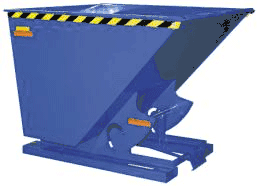
- Materials: Welded steel hopper body, reinforced steel base, and forklift-compatible steel pockets.
- Dump Angle: 70-degree self-dumping design for controlled discharge of bulk materials.
- Duty Range: Light-duty, medium-duty, and heavy-duty hopper configurations.
- Access Type: Forklift-mounted self-dumping hopper with automatic or manual dump release function.
- Applications: Scrap handling, waste collection, parts transfer, construction debris, and bulk material movement.

$1,859.98
$2,306.00
(You Save 19%)$1,959.98
$2,308.00
(You Save 15%)$2,298.98
$3,000.00
(You Save 23%)Product Comparison Chart
| Product | Duty Rating | Dump Angle | Primary Use | Handling Method |
|---|---|---|---|---|
| 70 Degree Self-Dumping Steel Hoppers Light Duty Hopper | Light Duty | 70 Degrees | Low-to-moderate volume waste, packaging, and lightweight scrap | Forklift-mounted dumping |
| 70 Degree Self-Dumping Steel Hopper Medium Duty Hopper | Medium Duty | 70 Degrees | General plant waste, production scrap, and bulk material transfer | Forklift-mounted dumping |
| 70 Degree Self-Dumping Steel Hoppers Heavy Duty Hopper | Heavy Duty | 70 Degrees | Dense scrap, metal chips, construction debris, and heavier industrial loads | Forklift-mounted dumping |
Configuration Analysis
70 degree self-dumping steel hoppers are designed to tilt forward and discharge contents once positioned over a receiving container, dumpster, or processing station. The 70-degree dump angle supports material flow for loose solids, scrap, chips, waste, and debris. Light-duty hoppers are suited for lower-density materials such as cardboard, plastic scrap, packaging waste, and general plant refuse. Medium-duty hoppers are used for broader industrial handling where material weight and loading frequency are higher. Heavy-duty hoppers are selected for dense or abrasive materials such as metal scrap, castings, construction debris, and production offcuts.
Material Engineering
These hoppers are commonly built from welded steel panels with reinforced stress points around the base, front lip, fork pockets, and pivot areas. Steel construction provides impact resistance during loading and dumping cycles. The hopper body shape allows gravity-assisted discharge while maintaining containment during forklift transport. Heavier-duty models generally use thicker steel, added reinforcement, or stronger structural framing to handle repeated loading from dense materials. Painted or coated exterior surfaces may be used to reduce surface corrosion in indoor industrial environments. For outdoor or chemical exposure, buyers should evaluate coating condition, drainage needs, and material compatibility.
Regulatory Standards
Self-dumping steel hoppers are workplace material handling equipment and should be used according to applicable facility safety rules, forklift operating procedures, and OSHA material handling practices. They are not typically classified as shipping containers for DOT hazardous material transport unless specifically rated and documented for that purpose. Operators should verify load capacity, secure engagement with forklift forks, and proper dump clearance before use. Facilities handling regulated waste, sharp scrap, oily chips, or hazardous residue should confirm internal waste handling procedures, labeling requirements, and containment controls before placing material into the hopper.
Industrial Applications
In manufacturing plants, 70 degree self-dumping hoppers are used near work cells, presses, CNC machines, packaging lines, and assembly stations to collect scrap and production waste. Metalworking facilities use them for chips, cutoffs, stampings, and reject parts. Warehouses use light-duty and medium-duty hoppers for cardboard, shrink wrap, broken pallets, and general cleanup. Construction and maintenance crews use heavy-duty models for debris, removed parts, and jobsite waste. Recycling operations use hoppers to stage sorted material before transfer into larger bins or processing equipment.
Selection Criteria
Buyers should select a hopper based on material weight, loading method, dump frequency, facility layout, and forklift capacity. Light-duty units reduce unnecessary weight where the load is bulky but not dense. Medium-duty units fit general-purpose plant handling where material type changes during daily use. Heavy-duty units are used where impact, abrasion, or load density is higher. The 70-degree dump angle should be matched to the flow behavior of the material. Fine, dry materials usually discharge more easily than damp, sticky, or irregular debris. Fork pocket size, overall hopper footprint, dump height, and receiving container clearance should be checked before purchase.

