


Industrial Drum Pumps & Fluid Transfer Systems
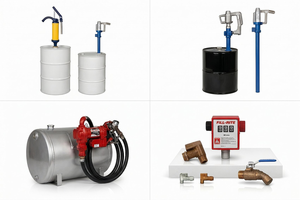
- Material Composition: Polypropylene, Stainless Steel, Aluminum, and Cast Iron.
- Power Sources: Manual Hand-Operated, Electric (AC/DC), and Pneumatic (Air-Powered).
- Flow Capacities: 5 GPM (Manual) to 35+ GPM (High-Volume Electric/Air).
- Compatibility: Water, Oils, Corrosive Chemicals, Fuels, and Solvents.

| Product Category | Primary Material | Power Source | Common Applications |
|---|---|---|---|
| Manual Drum Hand Pumps | Polypropylene / Steel | Manual (Rotary/Piston) | Low-volume chemical/oil transfer |
| Electric & Air Drum Pumps | Stainless Steel / PVDF | 110V AC / Pneumatic | High-volume industrial processing |
| Industrial Flowmeters | Aluminum / Technopolymer | Battery / Mechanical | Precision fluid measurement |
| Electric Fuel Pumps | Cast Iron / Aluminum | 12V/24V DC / 110V AC | Diesel and fuel distribution |
Manual Drum Hand Pumps serve as the primary solution for low-frequency dispensing or applications lacking access to power. These typically utilize rotary, piston, or siphon mechanisms to move fluid. Electric Drum Pumps are designed for high-volume, continuous duty cycles, utilizing 110V AC or 12V/24V DC motors to achieve rapid flow rates. For volatile environments, Air-Powered (Pneumatic) Pumps utilize compressed air to drive the motor, inherently eliminating the risk of electrical sparking. Each configuration is defined by its "immersion tube" length, which must correspond to the container depth to ensure complete fluid recovery and prevent cavitation during operation.
Material Engineering of its wetted parts. Polypropylene and PVDF bodies are standard for handling aggressive acids and corrosive chemicals due to their high chemical resistance. For petroleum-based products, lubricants, and non-corrosive solvents, aluminum or cast iron housings provide the necessary structural integrity. Stainless Steel (Type 316) is mandatory for food-grade, pharmaceutical, or highly flammable liquids, as it offers a non-reactive surface and can be effectively grounded. Internal seals, often composed of Viton, PTFE, or EPDM, must be matched to the fluid's chemical profile to prevent seal degradation and external leakage.
Regulatory Standards established by OSHA and the DOT. When handling flammable or combustible liquids, pumps must meet NFPA 30 standards, often requiring UL or FM-approved explosion-proof motors. Safety protocols for these transfers necessitate the use of grounding and bonding wires to dissipate static electricity, preventing ignition. Furthermore, in food and beverage production, pumps must comply with FDA or 3-A Sanitary Standards to ensure the equipment does not introduce contaminants. Utilizing UN-Rated containers in conjunction with sealed pump-to-bung connections maintains the integrity of the closed-loop system during hazardous material handling.
Industrial Applications for drum pumps span multiple technical sectors. In chemical manufacturing, these pumps facilitate the precise batching of raw materials into mixing vessels. The automotive and heavy equipment industries utilize high-viscosity gear oil pumps for drivetrain maintenance. In Agriculture, electric fuel pumps and chemical-resistant hand pumps are used for mobile refueling and pesticide distribution. Flowmeters, whether digital or mechanical, are often integrated into these systems to provide real-time data on fluid volume, which is critical for inventory management and ensuring exact mixing ratios in industrial chemical applications.
Determining the appropriate pump requires an assessment of Selection Criteria based on fluid dynamics. Viscosity is the primary factor; high-viscosity fluids like honey or heavy resins require specialized gear pumps or large-diameter piston pumps, whereas low-viscosity fluids like water or alcohols can be moved via centrifugal electric pumps. Buyers must also verify the Bung Adapter size, typically 2" NPT, to ensure a secure fit to the drum. The required flow rate (GPM) should align with the scale of the operation to minimize downtime. Finally, environmental factors, such as the presence of explosive vapors or the need for portability, dictate whether a pneumatic or battery-powered motor is the optimal choice.

