


Immersion Stem Thermometers for 55 Gallon Drums
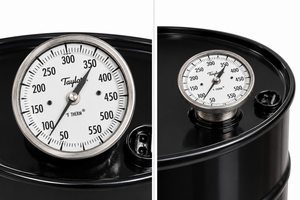
- Material Composition: Long-stem industrial thermometer construction for direct immersion in drum contents.
- Size/Capacity Range: Designed for 55-gallon drums with 18-inch stems.
- Temperature Ranges: 0°F to 250°F and 50°F to 550°F models.
- Measurement Type: Direct immersion temperature monitoring through drum openings.
- Applications: Drum heating, chemical processing, resins, oils, food materials, and viscous liquids.

$199.96
$149.96
(You Save -33%)$259.96
$305.00
(You Save 15%)Product Comparison Chart
Immersion Thermometer Configuration Immersion stem thermometers measure the temperature of material inside a drum rather than measuring only the exterior container surface. The 18-inch stem extends through a drum bung or other suitable access point and places the sensing portion of the thermometer closer to the bulk material. This configuration is particularly relevant for 55-gallon drums because temperature gradients can develop between the heated drum wall and the center of the contents. The 0°F to 250°F model covers the operating range associated with many conventional drum-heating processes, while the 50°F to 550°F configuration provides measurement capability for processes requiring substantially higher temperatures.
Material Engineering and Stem Construction Industrial immersion thermometers use elongated stems engineered for repeated exposure to process materials and elevated temperatures. Stem construction must provide sufficient rigidity for insertion while maintaining heat-transfer characteristics that allow the sensing element to respond to changes in the surrounding material. An 18-inch stem provides additional penetration depth compared with short laboratory or handheld probes. When measuring corrosive chemicals or reactive materials, buyers should verify that the stem material is chemically compatible with the stored substance. Surface condition, stem diameter, sensing-zone location, and thermometer housing construction can also affect suitability for industrial drum-heating environments.
Temperature Range and Measurement Considerations Selecting the thermometer range should be based on expected operating temperature rather than drum capacity alone. A 0°F to 250°F thermometer provides a scale focused on lower-temperature heating applications, while a 50°F to 550°F thermometer accommodates processes operating above the range of standard drum heaters. The measured temperature should remain within the instrument's specified scale. Direct immersion also reduces discrepancies associated with measuring only the exterior wall, particularly when heating thick oils, adhesives, waxes, resins, or other materials with low thermal conductivity. Placement depth and material circulation can influence the reading because temperatures may vary at different points within the drum.
Regulatory and Process Monitoring Immersion thermometers are monitoring instruments and do not independently establish DOT, OSHA, UN, or hazardous-material shipping compliance. Regulatory requirements depend on the material being handled, container specification, workplace conditions, and transportation classification. In heated chemical-processing environments, temperature readings can support operating procedures intended to maintain materials within specified processing or storage limits. When handling hazardous, combustible, or temperature-sensitive substances, thermometer selection should account for the manufacturer's allowable operating range and any facility-specific safety requirements. Temperature-monitoring equipment should be used in conjunction with the applicable drum, heater, ventilation, and material-handling procedures.
Industrial Applications Long-stem drum thermometers are used in chemical processing, manufacturing, agriculture, food handling, coatings, adhesives, petroleum products, and resin-processing operations. In drum-heating applications, direct measurement can be used to verify whether the internal contents have reached a specified transfer, mixing, pumping, or processing temperature. Viscous products may require heating before they can be pumped or dispensed, while temperature-sensitive materials may require monitoring to prevent exceeding established process limits. Immersion readings are also useful when exterior heater thermostats control heater output but do not directly measure the temperature at the center of the stored material.
Selection Criteria for Immersion Stem Thermometers Buyers should compare temperature range, stem length, material compatibility, access-opening dimensions, required insertion depth, and expected operating environment. The 18-inch stem should be evaluated against the drum configuration and material fill level to determine whether the sensing area will remain adequately immersed. The selected temperature scale should extend beyond the expected process temperature without placing normal operation at the extreme end of the instrument's range. Chemical compatibility is necessary when the stem contacts acids, solvents, oils, food products, or other process materials. Buyers should also consider whether the thermometer will be used continuously or only for periodic verification alongside a drum heater.
| Product | Drum Capacity | Stem Length | Temperature Range | Measurement Method | Primary Application |
|---|---|---|---|---|---|
| 55 Gallon Drum Thermometer 0-250°F with 18-Inch Stem | 55 Gallon | 18 Inches | 0°F to 250°F | Direct Immersion | Standard drum-heating and internal material monitoring |
| 55 Gallon Drum Thermometer 50-550°F with 18-Inch Stem | 55 Gallon | 18 Inches | 50°F to 550°F | Direct Immersion | Higher-temperature drum and process-material monitoring |
Immersion Thermometer Configuration Immersion stem thermometers measure the temperature of material inside a drum rather than measuring only the exterior container surface. The 18-inch stem extends through a drum bung or other suitable access point and places the sensing portion of the thermometer closer to the bulk material. This configuration is particularly relevant for 55-gallon drums because temperature gradients can develop between the heated drum wall and the center of the contents. The 0°F to 250°F model covers the operating range associated with many conventional drum-heating processes, while the 50°F to 550°F configuration provides measurement capability for processes requiring substantially higher temperatures.
Material Engineering and Stem Construction Industrial immersion thermometers use elongated stems engineered for repeated exposure to process materials and elevated temperatures. Stem construction must provide sufficient rigidity for insertion while maintaining heat-transfer characteristics that allow the sensing element to respond to changes in the surrounding material. An 18-inch stem provides additional penetration depth compared with short laboratory or handheld probes. When measuring corrosive chemicals or reactive materials, buyers should verify that the stem material is chemically compatible with the stored substance. Surface condition, stem diameter, sensing-zone location, and thermometer housing construction can also affect suitability for industrial drum-heating environments.
Temperature Range and Measurement Considerations Selecting the thermometer range should be based on expected operating temperature rather than drum capacity alone. A 0°F to 250°F thermometer provides a scale focused on lower-temperature heating applications, while a 50°F to 550°F thermometer accommodates processes operating above the range of standard drum heaters. The measured temperature should remain within the instrument's specified scale. Direct immersion also reduces discrepancies associated with measuring only the exterior wall, particularly when heating thick oils, adhesives, waxes, resins, or other materials with low thermal conductivity. Placement depth and material circulation can influence the reading because temperatures may vary at different points within the drum.
Regulatory and Process Monitoring Immersion thermometers are monitoring instruments and do not independently establish DOT, OSHA, UN, or hazardous-material shipping compliance. Regulatory requirements depend on the material being handled, container specification, workplace conditions, and transportation classification. In heated chemical-processing environments, temperature readings can support operating procedures intended to maintain materials within specified processing or storage limits. When handling hazardous, combustible, or temperature-sensitive substances, thermometer selection should account for the manufacturer's allowable operating range and any facility-specific safety requirements. Temperature-monitoring equipment should be used in conjunction with the applicable drum, heater, ventilation, and material-handling procedures.
Industrial Applications Long-stem drum thermometers are used in chemical processing, manufacturing, agriculture, food handling, coatings, adhesives, petroleum products, and resin-processing operations. In drum-heating applications, direct measurement can be used to verify whether the internal contents have reached a specified transfer, mixing, pumping, or processing temperature. Viscous products may require heating before they can be pumped or dispensed, while temperature-sensitive materials may require monitoring to prevent exceeding established process limits. Immersion readings are also useful when exterior heater thermostats control heater output but do not directly measure the temperature at the center of the stored material.
Selection Criteria for Immersion Stem Thermometers Buyers should compare temperature range, stem length, material compatibility, access-opening dimensions, required insertion depth, and expected operating environment. The 18-inch stem should be evaluated against the drum configuration and material fill level to determine whether the sensing area will remain adequately immersed. The selected temperature scale should extend beyond the expected process temperature without placing normal operation at the extreme end of the instrument's range. Chemical compatibility is necessary when the stem contacts acids, solvents, oils, food products, or other process materials. Buyers should also consider whether the thermometer will be used continuously or only for periodic verification alongside a drum heater.

