


Hazardous Area Temperature Controllers | TB110 Series
Free Shipping

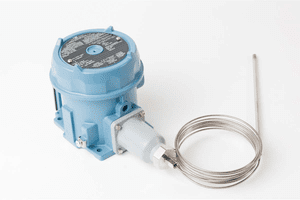
- Materials: 304 stainless steel bulb and capillary; hazardous-area rated enclosure.
- Temperature Ranges: 15°F to 140°F ambient sensing; 25°F to 325°F bulb and capillary sensing.
- Compliance: Class I Division 1 & 2 Groups B, C, D; Class II Division 1 & 2 Groups E, F, G; Class III; Class I Zone 1 Group IIB + H2 T6.
- Electrical Rating: 22 amps up to 480VAC with SPDT contacts.
- Configurations: Single set-point or dual set-point; ambient sensing or remote bulb and capillary sensing.

Product Comparison Chart
Set-Point and Sensing Configurations TB110 hazardous-area temperature controllers are available in single set-point and dual set-point formats. Single set-point models provide one switching threshold for maintaining a defined temperature range. Dual set-point models allow two independent control points, which may be used for staged heating, alarm integration, or upper and lower limit control. Ambient sensing models monitor surrounding air temperature, while bulb and capillary models use a remote sensing element for surface or process temperature measurement. The 10-foot capillary supports remote placement of the sensing bulb away from the enclosure.
Bulb, Capillary, and Enclosure Construction Remote sensing versions use a 304 stainless steel bulb and capillary assembly. Type 304 stainless steel provides corrosion resistance for general industrial exposure and supports use in process areas where moisture, washdown, or chemical vapor may be present. The enclosure is rated NEMA 7 and 9 for hazardous areas, providing protection for electrical switching components in locations where flammable gases, vapors, combustible dusts, or ignitable fibers may exist. The controller displays both °F and °C values and includes a 6°F or 3°C differential for switching response.
Hazardous Location Ratings The TB110 series is rated for Class I Division 1 and 2 Groups B, C, and D, covering atmospheres involving gases or vapors. Class II Division 1 and 2 Groups E, F, and G apply to combustible dust environments, while Class III applies to ignitable fibers or flyings. Additional classification includes Class I, Zone 1, Group IIB + H2 T6. Markings also include II 2 G Ex d IIC T6 Gb and II 2 D Ex tb IIIC T85°C Db IP66, with an ambient operating range of -40°C to 75°C.
Heat Tracing and Process Maintenance Uses These controllers are used in hazardous-area heat tracing systems for piping, tanks, valves, instrumentation, and process lines. In chemical processing, they regulate temperatures for fluid viscosity control, freeze protection, and transfer-line maintenance. In oil, gas, and petrochemical facilities, they support temperature control in classified production and storage zones. Agricultural, wastewater, and bulk material operations may use the controllers where combustible dusts or fibers are present. Ambient sensing models are suited for space or enclosure temperature control, while bulb and capillary models are used where direct surface or process temperature feedback is required.
Technical Factors for Controller Selection Selection depends on sensing location, required temperature range, electrical load, hazardous classification, and control logic. Ambient sensing should be selected where air temperature is the control variable. Bulb and capillary sensing should be selected where the controller must monitor pipe, vessel, or equipment surface temperature. Buyers should confirm that the 22 amp, 480VAC rating matches the connected heater load and that SPDT contacts are compatible with the control circuit. Environmental review should include maximum exposure temperature, classified area rating, enclosure requirements, and the required number of switching set-points.
Rated 22 amps up to 480VAC
304 stainless steel bulb and capillary, 10 feet (3m) long (remote sensing only)
Single pole double throw (SPDT) contacts
Enclosure rated NEMA 7 & 9, for hazardous areas
Displays both oF and oC
Differential 6oF (3oC)
Bulb and capillary average accuracy of ±5oF (3oC)
Bulb and capillary repeatability 1% of range
Maximum exposure temperature range: -40oF to 160oF (-40oC to 71oC)
Suitable for hazardous-area environments
Single or dual set-point
Bulb and capillary surface temperature control or ambient sensing
Numerous temperature range choices to fit your application
Class I Division 1 & 2 Group B, C, D
Class II Division 1 & 2 Group E, F, G
Class III
Class I, Zone 1, Group IIB + H2 T6
II 2 G Ex d IIC T6 Gb
II 2 D Ex tb IIIC T85°C Db IP66
Tamb = -40°C to 75°C
Ex d IIC T6 Gb
Ex tb IIIC T85°C Db IP66
Tamb = -40°C to 75°C
| Product | Set-Point Configuration | Sensing Type | Temperature Range | Electrical Rating | Hazardous Area Rating |
|---|---|---|---|---|---|
| TB110 Hazardous Area Temperature Controller | Single Set-Point | Ambient Sensing | 15°F to 140°F | 22 amps up to 480VAC | Class I Div. 1 & 2; Class II Div. 1 & 2; Class III; Zone 1 |
| TB110 Hazardous Area Temperature Controller | Single Set-Point | Bulb and Capillary | 25°F to 325°F | 22 amps up to 480VAC | Class I Div. 1 & 2; Class II Div. 1 & 2; Class III; Zone 1 |
| TB110 Hazardous Area Temperature Controller | Dual Set-Point | Bulb and Capillary | 25°F to 325°F | 22 amps up to 480VAC | Class I Div. 1 & 2; Class II Div. 1 & 2; Class III; Zone 1 |
Set-Point and Sensing Configurations TB110 hazardous-area temperature controllers are available in single set-point and dual set-point formats. Single set-point models provide one switching threshold for maintaining a defined temperature range. Dual set-point models allow two independent control points, which may be used for staged heating, alarm integration, or upper and lower limit control. Ambient sensing models monitor surrounding air temperature, while bulb and capillary models use a remote sensing element for surface or process temperature measurement. The 10-foot capillary supports remote placement of the sensing bulb away from the enclosure.
Bulb, Capillary, and Enclosure Construction Remote sensing versions use a 304 stainless steel bulb and capillary assembly. Type 304 stainless steel provides corrosion resistance for general industrial exposure and supports use in process areas where moisture, washdown, or chemical vapor may be present. The enclosure is rated NEMA 7 and 9 for hazardous areas, providing protection for electrical switching components in locations where flammable gases, vapors, combustible dusts, or ignitable fibers may exist. The controller displays both °F and °C values and includes a 6°F or 3°C differential for switching response.
Hazardous Location Ratings The TB110 series is rated for Class I Division 1 and 2 Groups B, C, and D, covering atmospheres involving gases or vapors. Class II Division 1 and 2 Groups E, F, and G apply to combustible dust environments, while Class III applies to ignitable fibers or flyings. Additional classification includes Class I, Zone 1, Group IIB + H2 T6. Markings also include II 2 G Ex d IIC T6 Gb and II 2 D Ex tb IIIC T85°C Db IP66, with an ambient operating range of -40°C to 75°C.
Heat Tracing and Process Maintenance Uses These controllers are used in hazardous-area heat tracing systems for piping, tanks, valves, instrumentation, and process lines. In chemical processing, they regulate temperatures for fluid viscosity control, freeze protection, and transfer-line maintenance. In oil, gas, and petrochemical facilities, they support temperature control in classified production and storage zones. Agricultural, wastewater, and bulk material operations may use the controllers where combustible dusts or fibers are present. Ambient sensing models are suited for space or enclosure temperature control, while bulb and capillary models are used where direct surface or process temperature feedback is required.
Technical Factors for Controller Selection Selection depends on sensing location, required temperature range, electrical load, hazardous classification, and control logic. Ambient sensing should be selected where air temperature is the control variable. Bulb and capillary sensing should be selected where the controller must monitor pipe, vessel, or equipment surface temperature. Buyers should confirm that the 22 amp, 480VAC rating matches the connected heater load and that SPDT contacts are compatible with the control circuit. Environmental review should include maximum exposure temperature, classified area rating, enclosure requirements, and the required number of switching set-points.

