


Industrial Storage Tanks | Liquid and Chemical Containers
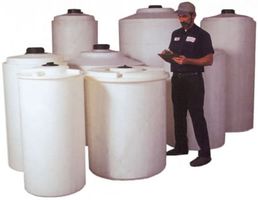
- Material Composition: High-Density Polyethylene (HDPE), Natural Resin.
- Size/Capacity Range: 75-Gallon to 500-Gallon capacities.
- Compliance/Ratings: FDA-compliant resins for potable water and food-grade storage.
- Configurations: Vertical Stationary, Horizontal Leg Tanks, and Integrated Pallet Tanks.


$499.98
| Product Name | Capacity | Dimensions / Type |
|---|---|---|
| 75 Gallon Storage Tank | 75 Gallons | Standard Vertical |
| 120 Gallon Storage Tank | 120 Gallons | Standard Vertical |
| 160 Gallon Storage Tank | 160 Gallons | Standard Vertical |
| 175 Gallon Storage Tank | 175 Gallons | Standard Vertical |
| 190 Gallon Storage Tank | 190 Gallons | Standard Vertical |
| 250 Gallon Storage Tank | 250 Gallons | Standard Vertical |
| 300 Gallon Storage Tank | 300 Gallons | Standard Vertical |
| 500 Gallon Storage Tank | 500 Gallons | Standard Vertical |
| 300 Gallon Storage Tank (Wide) | 300 Gallons | 48" x 55" |
| 210 Gallon Pallet and Tank | 210 Gallons | Palletized Base |
| 220 Gallon Horizontal Leg Tank | 220 Gallons | Horizontal / Natural HDPE |
Tank Geometries and Structural Design Industrial storage tanks are categorized by their physical configuration to suit specific operational needs. Vertical storage tanks are the industry standard for stationary applications, utilizing a flat-bottom design that requires a level, reinforced surface. These tanks maximize volume while minimizing floor space. Horizontal leg tanks are engineered with molded-in "legs" that provide stability and prevent rolling. This configuration is used for mobile applications or where a lower center of gravity is required. Specialized units, such as palletized tanks, integrate the vessel with a transportable base, allowing for movement via forklift or pallet jack when the container is empty or partially filled, depending on the base's load rating.
Polyethylene Properties and Chemical Resistance The primary material used in these storage tanks is High-Density Polyethylene (HDPE). This thermoplastic polymer is selected for its high strength-to-density ratio and chemical inertness. HDPE is resistant to a broad spectrum of chemicals, including many acids, bases, and salts. The rotational molding process ensures a seamless, one-piece construction, which eliminates stress points and potential leak paths found in welded containers. Natural HDPE is translucent, allowing operators to monitor liquid levels without external gauges. For outdoor applications, UV-stabilized resins are employed to prevent the polymer chains from breaking down under prolonged exposure to direct sunlight.
Compliance and Safety Ratings Storage tanks must adhere to specific regulatory standards depending on their intended contents. For the storage of drinking water and food products, tanks are manufactured from FDA-compliant resins that meet 21 CFR 177.1520 requirements for food contact. While HDPE tanks are suitable for many industrial chemicals, the specific gravity of the liquid must be considered; standard tanks are typically rated for liquids with a specific gravity of 1.0 to 1.5. For hazardous material transport, containers must meet Department of Transportation (DOT) or UN specifications, though many stationary storage tanks are governed by OSHA 1910.106 standards regarding the storage of flammable and combustible liquids.
Sector-Specific Utility In the agricultural sector, these tanks are used for the bulk storage of fertilizers, pesticides, and irrigation water. The horizontal leg tank configuration is frequently mounted on trailers for field application. In chemical manufacturing, HDPE tanks serve as primary containment for process chemicals and intermediate bulk storage. The food and beverage industry utilizes FDA-compliant vertical tanks for the storage of ingredients and potable water. Additionally, these vessels are employed in water treatment facilities for the containment of coagulants, disinfectants, and pH adjusters, where corrosion resistance is a technical requirement.
Technical Factors for Procurement When selecting a storage tank, the chemical compatibility of the stored medium with HDPE must be verified using a standard chemical resistance chart. Physical environment factors, such as temperature fluctuations, also impact material performance; HDPE typically maintains structural integrity within a range of -40°F to 120°F. Buyers must evaluate the footprint requirements and the necessity of secondary containment to meet local environmental regulations. Fitting requirements, including the size and material of bulkheads, valves, and vents, must be specified to ensure leak-proof integration with existing piping or dispensing systems. Capacity selection should include a buffer for thermal expansion and foam head space.

