


Industrial Round Seamless Tins & Slip-On Covers
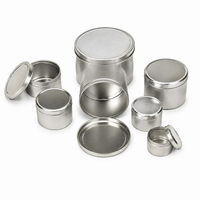
- Material Composition: Seamless metal tinplate construction for industrial packaging and component storage.
- Size Range: 1/2 oz to 16 oz capacities, including flat and deep tin configurations.
- Closure Types: Separate slip-on covers and matching bottom tin bodies.
- Pack Quantities: 48-pack, 100-pack, and 1000-pack case options.
- Configurations: Flat round seamless tins and deep round seamless tins.

$129.96
$151.00
(You Save 14%)$49.98
$69.98
(You Save 29%)$69.96
$109.96
(You Save 36%)$239.96
$299.96
(You Save 20%)$49.98
$69.98
(You Save 29%)$229.98
$270.00
(You Save 15%)$39.98
$33.98
(You Save -18%)$149.98
$127.48
(You Save -18%)
Product Comparison Chart
Configuration Analysis
Industrial round seamless tins in this section are organized by flat and deep profiles, with separate top and bottom components. Flat tins are lower-profile containers used where compact fill volume, shallow product presentation, or space-efficient storage is required. Deep tins provide increased vertical capacity for taller fills, stacked components, denser materials, or products that require more headspace. The range includes 1/2 oz, 1 oz, 2 oz, 3 oz, 4 oz, 6 oz, 8 oz, and 16 oz sizes depending on profile type. Slip-on covers are sold as separate top components, allowing buyers to pair covers with corresponding bottom bodies according to capacity and tin depth. This two-component format supports replacement cover purchasing, production-line staging, and separate inventory management for lids and bases.
Material Engineering Seamless metal tin construction eliminates a vertical side seam on the body, which supports uniform wall geometry and a clean cylindrical shape. Tinplate containers are commonly used where moderate barrier protection, dimensional consistency, and rigid small-format packaging are required. The metal body provides resistance to crushing during ordinary handling compared with flexible pouches or paperboard cartons. Flat bottoms allow stable placement on filling tables, shelves, and packaging lines. Slip-on covers are designed to fit over the rim of the matching tin body, creating a friction-based closure without threaded hardware, hinges, or snap mechanisms. Buyers should verify whether interior coatings, lacquered finishes, or bare-metal contact surfaces are required based on the contents being packaged.
Regulatory Standards These industrial round seamless tins are not identified as UN-rated hazardous-material containers in the provided product list. Buyers using tins for regulated materials should confirm whether the filled package requires DOT, OSHA Hazard Communication, or carrier-specific packaging compliance. Small tins may be used as inner packaging within larger compliant outer cartons when permitted by the applicable shipping classification. For food, cosmetic, pharmaceutical, or chemical sample use, compatibility documentation and any applicable food-contact or product-contact requirements should be reviewed before filling. Slip-on lids may reduce incidental exposure during storage, but they should not be treated as pressure-rated, leakproof, child-resistant, or tamper-evident unless those properties are documented.
Industrial Applications Flat and deep round seamless tins are used across manufacturing, laboratory, craft, maintenance, and specialty packaging environments. Chemical and coatings operations may use small tins for pigment samples, waxes, resins, adhesives, or retained production samples when material compatibility is confirmed. Industrial maintenance teams may use them for fasteners, washers, fittings, shims, and small replacement parts. Cosmetic and personal-care producers may use matching tops and bottoms for balms, salves, solid fragrances, or sample-size formulations when contact requirements are met. Agricultural and field-service users may package seed samples, soil specimens, dry additives, or testing materials. The 1000-pack options support higher-volume packaging runs, while 48-pack and 100-pack formats support batch production and inventory trials.
Selection Criteria Selection should begin with capacity, fill type, and profile depth. A 1/2 oz or 1 oz tin is suited to small samples or compact components, while 8 oz and 16 oz deep tins provide additional internal volume for larger fills. Buyers should match slip-on covers to the exact tin capacity and profile, since flat and deep versions may not share the same lid fit. Contents should be reviewed for corrosion potential, staining, odor transfer, moisture sensitivity, and reaction with metal surfaces. Storage environment is also relevant; high-humidity areas may require controlled conditions or coated containers. For shipping, buyers should evaluate closure retention, carton orientation, vibration exposure, and whether secondary packaging is needed to keep covers seated during transit.
| Product Type | Capacity | Profile | Component | Pack Quantity |
|---|---|---|---|---|
| Industrial Round Seamless Tin | 1/2 oz | Flat | Slip-On Top Cover | 48 Pack |
| Industrial Round Seamless Tin | 1/2 oz | Flat | Bottom Body | 48 Case Pack |
| Industrial Round Seamless Tin | 1 oz | Flat | Slip-On Top Cover | 1000 Pack |
| Industrial Round Seamless Tin | 1 oz | Flat | Bottom Body | 1000 Case Pack |
| Industrial Round Seamless Tin | 2 oz | Flat | Top Cover | 1000 Pack |
| Industrial Round Seamless Tin | 2 oz | Flat | Bottom Body | 1000 Case Pack |
| Industrial Round Seamless Tin | 3 oz | Flat | Top Cover | 1000 Case Pack |
| Industrial Round Seamless Tin | 3 oz | Flat | Bottom Body | 100 Pack |
| Industrial Round Seamless Tin | 4 oz | Flat | Slip-On Top Cover | 100 Pack |
| Industrial Round Seamless Tin | 4 oz | Flat | Bottom Body | 100 Pack |
| Industrial Round Seamless Tin | 8 oz | Flat | Slip-On Top Cover | 100 Pack |
| Industrial Round Seamless Tin | 8 oz | Flat | Bottom Body | 100 Pack |
| Industrial Round Seamless Tin | 1 oz to 16 oz | Deep | Slip-On Covers and Bottom Bodies | 100 Pack |
Industrial round seamless tins in this section are organized by flat and deep profiles, with separate top and bottom components. Flat tins are lower-profile containers used where compact fill volume, shallow product presentation, or space-efficient storage is required. Deep tins provide increased vertical capacity for taller fills, stacked components, denser materials, or products that require more headspace. The range includes 1/2 oz, 1 oz, 2 oz, 3 oz, 4 oz, 6 oz, 8 oz, and 16 oz sizes depending on profile type. Slip-on covers are sold as separate top components, allowing buyers to pair covers with corresponding bottom bodies according to capacity and tin depth. This two-component format supports replacement cover purchasing, production-line staging, and separate inventory management for lids and bases.
Material Engineering Seamless metal tin construction eliminates a vertical side seam on the body, which supports uniform wall geometry and a clean cylindrical shape. Tinplate containers are commonly used where moderate barrier protection, dimensional consistency, and rigid small-format packaging are required. The metal body provides resistance to crushing during ordinary handling compared with flexible pouches or paperboard cartons. Flat bottoms allow stable placement on filling tables, shelves, and packaging lines. Slip-on covers are designed to fit over the rim of the matching tin body, creating a friction-based closure without threaded hardware, hinges, or snap mechanisms. Buyers should verify whether interior coatings, lacquered finishes, or bare-metal contact surfaces are required based on the contents being packaged.
Regulatory Standards These industrial round seamless tins are not identified as UN-rated hazardous-material containers in the provided product list. Buyers using tins for regulated materials should confirm whether the filled package requires DOT, OSHA Hazard Communication, or carrier-specific packaging compliance. Small tins may be used as inner packaging within larger compliant outer cartons when permitted by the applicable shipping classification. For food, cosmetic, pharmaceutical, or chemical sample use, compatibility documentation and any applicable food-contact or product-contact requirements should be reviewed before filling. Slip-on lids may reduce incidental exposure during storage, but they should not be treated as pressure-rated, leakproof, child-resistant, or tamper-evident unless those properties are documented.
Industrial Applications Flat and deep round seamless tins are used across manufacturing, laboratory, craft, maintenance, and specialty packaging environments. Chemical and coatings operations may use small tins for pigment samples, waxes, resins, adhesives, or retained production samples when material compatibility is confirmed. Industrial maintenance teams may use them for fasteners, washers, fittings, shims, and small replacement parts. Cosmetic and personal-care producers may use matching tops and bottoms for balms, salves, solid fragrances, or sample-size formulations when contact requirements are met. Agricultural and field-service users may package seed samples, soil specimens, dry additives, or testing materials. The 1000-pack options support higher-volume packaging runs, while 48-pack and 100-pack formats support batch production and inventory trials.
Selection Criteria Selection should begin with capacity, fill type, and profile depth. A 1/2 oz or 1 oz tin is suited to small samples or compact components, while 8 oz and 16 oz deep tins provide additional internal volume for larger fills. Buyers should match slip-on covers to the exact tin capacity and profile, since flat and deep versions may not share the same lid fit. Contents should be reviewed for corrosion potential, staining, odor transfer, moisture sensitivity, and reaction with metal surfaces. Storage environment is also relevant; high-humidity areas may require controlled conditions or coated containers. For shipping, buyers should evaluate closure retention, carton orientation, vibration exposure, and whether secondary packaging is needed to keep covers seated during transit.

