


Reverse Tuck Chipboard Cartons | Folding Carton Boxes
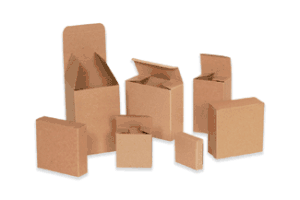
- Material Composition: Paperboard chipboard construction; kraft and white carton options.
- Size Range: From 1 1/2" x 1 1/2" x 2 1/4" through 4 1/4" x 1 1/4" x 4 1/4".
- Case Quantities: Available configurations include 250-, 500-, and 1,000-carton case packs.
- Closure Type: Reverse tuck end construction with opposing top and bottom tuck flaps.
- Configuration: Folding chipboard cartons supplied in multiple rectangular and square dimensional formats.
[Contact us for a price] Reverse Tuck Chipboard Cartons

Product Comparison Chart
Configuration Analysis Reverse tuck cartons are manufactured from a single die-cut and scored sheet that folds into a rectangular or square package. The defining structural feature is the orientation of the primary tuck flaps: the top flap folds toward one panel while the bottom flap folds in the opposite direction. This differs from straight tuck cartons, where both primary closure flaps normally fold toward the same side. Reverse tuck construction can reduce material requirements during carton layout because the opposing flaps can be nested efficiently on the paperboard sheet. The listed products cover compact square cartons, narrow elongated cartons, and deeper rectangular configurations. Dimensions such as 2" x 2" x 3", 3" x 3" x 6", and 3 1/2" x 2 1/2" x 5 1/2" allow the carton geometry to be matched to product width, depth, and height.
Material Engineering Chipboard folding cartons are produced from paperboard engineered to provide dimensional stability while remaining flexible enough for scoring, folding, and tuck closure operations. The material is thinner and lighter than corrugated fiberboard and is generally intended for individual product packaging rather than standalone heavy-duty shipping. Carton performance depends on paperboard caliper, fiber composition, scoring depth, panel dimensions, and the weight of the packaged item. Kraft-colored chipboard provides an uncoated natural paperboard appearance, while white cartons provide a light exterior surface suited to labeling, identification, or printed product information. Fold lines are mechanically scored so panels form defined edges without uncontrolled cracking. Tuck flaps and dust flaps interlock through carton geometry rather than permanent top or bottom adhesive closures.
Regulatory Standards and Packaging Considerations Reverse tuck chipboard cartons should not be treated as UN performance packaging unless a specific completed packaging system has been tested and marked for hazardous-material transportation. Standard folding chipboard cartons are commonly used as inner or retail-style packages and may require placement inside an approved outer shipping container when transported through parcel, freight, or regulated hazardous-material channels. DOT hazardous-material requirements depend on the substance, quantity, packaging group, and complete package configuration rather than the folding carton alone. OSHA requirements may also affect labeling when cartons contain workplace chemicals, including hazard communication information where applicable. Food, pharmaceutical, cosmetic, or medical applications can require additional material-contact, cleanliness, tamper-evidence, or labeling controls based on the packaged product.
Industrial Applications Reverse tuck chipboard cartons are used for packaging lightweight manufactured parts, hardware, electrical components, cosmetics, personal-care items, laboratory supplies, small bottles, tubes, packaged foods, dry goods, and agricultural components. Narrow formats such as 1 3/4" x 1 3/4" x 6" can accommodate elongated products, while configurations such as 3" x 3" x 3" provide a more uniform cubic interior. Taller 3" x 3" x 6" cartons can be used for bottles or vertically oriented components. White carton variants can support applications requiring visible product coding, inventory labels, instructions, or branding graphics. For distribution, individual chipboard cartons are commonly consolidated into corrugated shipping cases to improve stacking strength and resistance to crushing, abrasion, and handling impacts.
Selection Criteria Carton selection should begin with the product's maximum external dimensions, allowing sufficient clearance for insertion without excessive empty space. Buyers should verify the dimension sequence used by the supplier before selecting a carton because length, width, and depth conventions can vary between packaging categories. Product weight should also be evaluated against paperboard strength, particularly for dense metal parts, glass containers, or items with sharp edges. Additional factors include desired exterior color, labeling method, required case quantity, storage humidity, stacking conditions, and whether the carton will function as an inner package or final shipping container. Applications involving liquids, oils, moisture, chemicals, or direct food contact require evaluation of paperboard compatibility and any necessary liners, bags, coatings, or secondary containment.
| Carton Size | Case Pack | Color / Finish | Configuration |
|---|---|---|---|
| 1 1/2" x 1 1/2" x 2 1/4" | Not specified | Chipboard | Reverse Tuck |
| 1 3/4" x 1 3/4" x 6" | 500 | Chipboard | Reverse Tuck |
| 2" x 2" x 3" | 1,000 | Chipboard | Reverse Tuck |
| 2" x 2" x 4" | 1,000 | Chipboard | Reverse Tuck |
| 2 1/2" x 1 3/4" x 4" | 500 | Standard Chipboard | Reverse Tuck |
| 2 1/2" x 1 3/4" x 4" | 500 | White | Reverse Tuck |
| 2 1/2" x 2 1/2" x 4" | 500 | Chipboard | Reverse Tuck |
| 2 1/2" x 2 1/2" x 6" | 250 | Chipboard | Reverse Tuck |
| 3" x 2" x 5" | 500 | Chipboard | Reverse Tuck |
| 3" x 3" x 3" | 250 | Chipboard | Reverse Tuck |
| 3" x 3" x 4" | 250 | Chipboard | Reverse Tuck |
| 3" x 3" x 6" | 250 | Chipboard | Reverse Tuck |
| 3 1/2" x 2 1/2" x 5 1/2" | 250 | Standard Chipboard | Reverse Tuck |
| 3 1/2" x 2 1/2" x 5 1/2" | Not specified | Alternate Listed Variant | Reverse Tuck |
| 4 1/4" x 1 1/4" x 4 1/4" | 500 | Chipboard | Reverse Tuck |
Configuration Analysis Reverse tuck cartons are manufactured from a single die-cut and scored sheet that folds into a rectangular or square package. The defining structural feature is the orientation of the primary tuck flaps: the top flap folds toward one panel while the bottom flap folds in the opposite direction. This differs from straight tuck cartons, where both primary closure flaps normally fold toward the same side. Reverse tuck construction can reduce material requirements during carton layout because the opposing flaps can be nested efficiently on the paperboard sheet. The listed products cover compact square cartons, narrow elongated cartons, and deeper rectangular configurations. Dimensions such as 2" x 2" x 3", 3" x 3" x 6", and 3 1/2" x 2 1/2" x 5 1/2" allow the carton geometry to be matched to product width, depth, and height.
Material Engineering Chipboard folding cartons are produced from paperboard engineered to provide dimensional stability while remaining flexible enough for scoring, folding, and tuck closure operations. The material is thinner and lighter than corrugated fiberboard and is generally intended for individual product packaging rather than standalone heavy-duty shipping. Carton performance depends on paperboard caliper, fiber composition, scoring depth, panel dimensions, and the weight of the packaged item. Kraft-colored chipboard provides an uncoated natural paperboard appearance, while white cartons provide a light exterior surface suited to labeling, identification, or printed product information. Fold lines are mechanically scored so panels form defined edges without uncontrolled cracking. Tuck flaps and dust flaps interlock through carton geometry rather than permanent top or bottom adhesive closures.
Regulatory Standards and Packaging Considerations Reverse tuck chipboard cartons should not be treated as UN performance packaging unless a specific completed packaging system has been tested and marked for hazardous-material transportation. Standard folding chipboard cartons are commonly used as inner or retail-style packages and may require placement inside an approved outer shipping container when transported through parcel, freight, or regulated hazardous-material channels. DOT hazardous-material requirements depend on the substance, quantity, packaging group, and complete package configuration rather than the folding carton alone. OSHA requirements may also affect labeling when cartons contain workplace chemicals, including hazard communication information where applicable. Food, pharmaceutical, cosmetic, or medical applications can require additional material-contact, cleanliness, tamper-evidence, or labeling controls based on the packaged product.
Industrial Applications Reverse tuck chipboard cartons are used for packaging lightweight manufactured parts, hardware, electrical components, cosmetics, personal-care items, laboratory supplies, small bottles, tubes, packaged foods, dry goods, and agricultural components. Narrow formats such as 1 3/4" x 1 3/4" x 6" can accommodate elongated products, while configurations such as 3" x 3" x 3" provide a more uniform cubic interior. Taller 3" x 3" x 6" cartons can be used for bottles or vertically oriented components. White carton variants can support applications requiring visible product coding, inventory labels, instructions, or branding graphics. For distribution, individual chipboard cartons are commonly consolidated into corrugated shipping cases to improve stacking strength and resistance to crushing, abrasion, and handling impacts.
Selection Criteria Carton selection should begin with the product's maximum external dimensions, allowing sufficient clearance for insertion without excessive empty space. Buyers should verify the dimension sequence used by the supplier before selecting a carton because length, width, and depth conventions can vary between packaging categories. Product weight should also be evaluated against paperboard strength, particularly for dense metal parts, glass containers, or items with sharp edges. Additional factors include desired exterior color, labeling method, required case quantity, storage humidity, stacking conditions, and whether the carton will function as an inner package or final shipping container. Applications involving liquids, oils, moisture, chemicals, or direct food contact require evaluation of paperboard compatibility and any necessary liners, bags, coatings, or secondary containment.

