


HAZ-STOR Outdoor Flammable Storage Safety Buildings
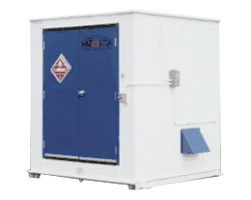
- Material Composition: Heavy-gauge galvanized steel with fire-rated wall construction.
- Capacity Range: 9-drum to 75-drum storage configurations.
- Compliance/Ratings: UL Classified, FM Approved, and NFPA 30 compliant.
- Safety Features: Built-in secondary containment sumps and explosion-relief panels.
HAZ-STOR Outdoor Flammable Storage Safety Buildings are engineered structures designed for the compliant secondary containment and isolation of flammable and combustible materials. These units accommodate capacities ranging from 9 to 75 drums, providing a localized storage solution that meets environmental and safety regulations. Constructed from heavy-duty steel with specialized fire-rated insulation, these buildings mitigate risks associated with chemical spills and combustion. They are utilized in industrial sectors to maintain separation distances from occupied structures while ensuring secure, weather-resistant storage for hazardous substances in drums or intermediate bulk containers (IBCs).

| Product Model | Drum Capacity | Primary Application |
|---|---|---|
| HAZ-STOR Outdoor Flammable Storage Building 9 Drum | 9 Drums | Small-scale hazardous waste collection |
| HAZ-STOR Outdoor Flammable Storage Building 12 Drum | 12 Drums | Low-volume chemical storage |
| HAZ-STOR Outdoor Flammable Storage Building 15 Drum | 15 Drums | Mid-range industrial fluid containment |
| HAZ-STOR Outdoor Flammable Storage Building 21 Drum | 21 Drums | Standard manufacturing material isolation |
| HAZ-STOR Outdoor Flammable Storage Building 27 Drum | 27 Drums | Bulk raw material storage |
| HAZ-STOR Outdoor Flammable Storage Building 33 Drum | 33 Drums | Large-scale chemical processing support |
| HAZ-STOR Outdoor Flammable Storage Building 39 Drum | 39 Drums | High-capacity environmental compliance |
| HAZ-STOR Outdoor Flammable Storage Building 45 Drum | 45 Drums | Agricultural chemical distribution hubs |
| HAZ-STOR Outdoor Flammable Storage Building 60 Drum | 60 Drums | Industrial-scale waste management |
| HAZ-STOR Outdoor Flammable Storage Building 75 Drum | 75 Drums | High-volume hazardous logistics |
Structural Engineering and Layout The configuration of outdoor flammable storage buildings is determined by drum capacity and the required footprint for maneuverability. Smaller units, such as the 9-drum and 12-drum models, often feature single-tier storage with wide-access doors for manual or pallet jack loading. Larger configurations, scaling up to 75 drums, utilize multi-tier racking systems and oversized double doors to facilitate forklift access. These buildings are designed with integrated forklift pockets to allow for relocation when empty. Internal layouts prioritize airflow and access to secondary containment sumps, ensuring that any leaks are captured beneath the floor grating for safe extraction.
Fire-Rated Walls and Protective Coatings The integrity of these buildings depends on material thickness and thermal insulation. Construction typically involves heavy-gauge steel shells with non-combustible mineral wool insulation or gypsum board layers to achieve 2-hour or 4-hour fire ratings. The exterior is finished with high-performance epoxy or polyurethane coatings to prevent corrosion from UV exposure and industrial pollutants. Interior floor gratings are manufactured from galvanized steel or chemical-resistant plastics to support the weight of full drums while allowing leaked fluids to pass through to the leak-tight containment sump, which is tested for hydraulic integrity.
UN, OSHA, and NFPA Compliance Hazardous material storage is governed by strict regulatory frameworks including NFPA 30 (Flammable and Combustible Liquids Code) and OSHA 1910.106. HAZ-STOR buildings are engineered to meet these standards by incorporating explosion-relief panels, which vent pressure upward and away from personnel in the event of an internal ignition. Furthermore, the secondary containment sumps are sized to hold at least 10% of the total volume of the containers or 100% of the largest container, whichever is greater, in accordance with EPA and SPCC requirements. UL Classification and FM Approval signify that the structural components have undergone rigorous fire and impact testing.
Sector-Specific Deployment These storage buildings are deployed across diverse sectors including chemical manufacturing, automotive assembly, and commercial agriculture. In chemical plants, they serve as satellite accumulation points for hazardous waste. In the agricultural sector, they provide secure containment for pesticides and fertilizers that require separation from general inventory. Research laboratories and pharmaceutical facilities utilize these buildings to house volatile solvents outside the main laboratory envelope, thereby reducing the fire load within the primary facility and lowering insurance premiums associated with indoor hazardous material storage.
Technical Environmental Factors When selecting a flammable storage building, engineers must evaluate chemical compatibility and local environmental conditions. Compatibility ensures that the internal sump lining and wall materials will not degrade when exposed to specific stored vapors or liquids. Environmental factors include wind load ratings for coastal areas and snow load capacities for northern climates. Buyers must also calculate the required distance from property lines and other buildings to determine if a non-combustible, 2-hour, or 4-hour fire-rated structure is mandatory under local building codes. Ventilation requirements, whether natural or forced-air, are determined by the volatility of the materials stored.

