


Compact Safety Cabinets | Small Footprint Flammable Storage
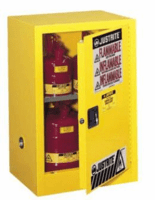
- Material Composition: 18-Gauge Double-Wall Cold-Rolled Steel.
- Size/Capacity Range: 12-Gallon to 22-Gallon Industrial Storage.
- Compliance/Ratings: OSHA 1910.106; NFPA Code 30; FM Approved.
- Closure Types: Manual-Close and Self-Closing Single/Double Doors.

| Product Description | Capacity | Dimensions (H x W x D) | Door Configuration | Closure Type |
|---|---|---|---|---|
| Compact Safety Cabinet | 12 Gallon | 35" x 23" x 18" | 1-Door | Manual |
| Compact Safety Cabinet | 12 Gallon | 35" x 23" x 18" | 1-Door | Self-Close |
| Compact Safety Cabinet | 15 Gallon | 44" x 23" x 18" | 1-Door | Manual |
| Compact Safety Cabinet | 15 Gallon | 44" x 23" x 18" | 1-Door | Self-Close |
| Compact Safety Cabinet | 22 Gallon | 35" x 35" x 22" | 2-Door | Manual |
| Compact Safety Cabinet | 22 Gallon | 35" x 35" x 22" | 2-Door | Self-Close |
Single and Double Door Geometry The configuration of compact safety cabinets is optimized for accessibility in restricted environments. The 12 and 15-gallon models utilize a single-door design, which reduces the swing radius required for opening, making them suitable for placement in corners or at the end of workbenches. The 22-gallon model features a double-door configuration with a 35-inch width, providing a wider access point for bulkier containers while maintaining a low-profile height. Closure mechanisms are divided into manual-close types, which open to a full 180 degrees, and self-closing models. Self-closing units incorporate a specialized hidden mechanism that ensures the doors automatically shut and latch if a fusible link melts at 165°F during a fire event.
Thermal Resistance and Substrate Protection Compact cabinets are manufactured from high-strength 18-gauge steel using all-welded construction to eliminate gaps. The material engineering focuses on the "double-wall" principle, creating a 1.5-inch air gap that serves as a thermal insulator against external heat. To prevent corrosion from chemical spills or aggressive vapors, both the interior and exterior surfaces are finished with a lead-free epoxy-phenolic powder coating. The cabinets include a 2-inch deep leak-proof sump at the bottom to ensure accidental spills are contained within the unit. Shelves are galvanized steel, designed to direct spills toward the back and bottom of the cabinet to prevent liquid accumulation on the storage surface.
OSHA and NFPA Fire Safety Compliance Every compact cabinet in this category is built to satisfy the requirements of OSHA 29 CFR 1910.106 and NFPA Code 30. These standards dictate the construction materials, venting requirements, and labeling necessary for storing flammable liquids safely indoors. These units are FM Approved, signifying they have passed rigorous independent fire tests. A critical regulatory feature is the inclusion of dual 2-inch threaded vents with integrated flame arresters, which prevent flash-back from external ignition sources. The use of self-closing doors is a specific technical requirement in many jurisdictions following the International Fire Code (IFC) to ensure the cabinet remains a sealed fire barrier when not in use.
Point-of-Use Safety in Technical Sectors Compact cabinets are widely deployed in sectors where localized storage of small volumes of flammable liquids is necessary for efficiency. In pharmaceutical and university laboratories, 12-gallon cabinets are placed under hoods or near benches to store daily-use solvents. Maintenance departments in automotive and aerospace facilities use 15-gallon units to secure cleaning fluids and lubricants directly at the repair station. The 22-gallon cabinets are often utilized in industrial mixing rooms to hold smaller quantities of resins or additives that must be segregated from main bulk storage. Their non-magnetic and fire-rated properties also make them suitable for electronics manufacturing environments.
Technical Assessment for Compact Storage Selection of a compact cabinet depends on the specific volume of Class I and II liquids required at a single workstation. Technical buyers must evaluate the height constraints of the installation site; for example, the 44-inch high 15-gallon model provides vertical storage, while the 35-inch high 12-gallon model may fit under standard industrial counters. The choice between manual and self-closing doors should be based on a facility’s risk assessment and local fire marshal requirements. Additionally, the depth of the unit (ranging from 18 to 22 inches) must be compatible with aisle clearance and safety egress paths. Ensuring the cabinet's load-bearing capacity matches the intended weight of the stored safety cans is essential for long-term structural integrity.

