


Rubbermaid Ingredient Bins & Sliding Lids
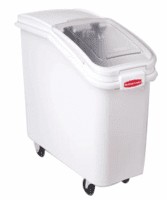
- Material Composition: Commercial-grade polyethylene bin bodies with plastic sliding or hinged lids.
- Capacity Range: 2 3/4, 3 1/2, and 3 3/4 cubic-foot configurations.
- Compliance: Designed for bulk ingredient storage; confirm model-specific food-contact and NSF documentation.
- Closure Types: Sliding lids, sliding hinged lids, flat-top covers, and slant-front access lids.
- Accessories: Select configurations include a 32-ounce scoop; replacement lids fit specified bin models.

$399.96
$550.00
(You Save 27%)$399.96
$576.10
(You Save 31%)$399.96
$519.95
(You Save 23%)$499.96
$529.95
(You Save 6%)$139.96
$181.85
(You Save 23%)$129.98
$169.99
(You Save 24%)Product Comparison Chart
Slant-Front Ingredient Bins Slant-front bins position the access opening at an angle, allowing users to reach stored ingredients without removing the entire cover. The sliding lid moves along the upper portion of the bin and helps limit exposure while ingredients are being measured. This configuration is used where frequent access is required during preparation, batching, or production. Listed slant-front models include capacities of 2 3/4 and 3 1/2 cubic feet, along with a configuration supplied with a sliding lid and 32-ounce scoop.
Flat-Top Ingredient Bins Flat-top bins use a horizontal upper profile and a sliding hinged lid. This format provides controlled access while maintaining a compact container shape. The listed 3 3/4-cubic-foot model provides the largest stated capacity in this section. Flat-top construction may be suited to storage areas where overhead clearance, placement beneath work surfaces, or alignment with surrounding equipment must be considered.
Replacement Lid Configurations Replacement sliding lids allow damaged or missing covers to be replaced without purchasing a complete bin. Compatibility is model-specific. One listed lid fits Rubbermaid 83600-88 bins, while another fits 83602-88 bins. Both include a 32-ounce scoop. Buyers should verify the bin model number, lid dimensions, hinge or track arrangement, and scoop-storage location before selecting a replacement component.
Polyethylene Construction Commercial ingredient bins are commonly manufactured from molded polyethylene because the material resists moisture, does not corrode, and can be formed into seamless container bodies. Molded walls reduce joints where dry particles may collect. Material thickness, reinforcement ribs, wheel housings, lid tracks, and impact zones vary by model. Product documentation should be reviewed when load limits, temperature exposure, or cleaning chemicals are operational concerns.
Lid and Scoop Components Sliding and hinged lids are engineered to provide repeated access while reducing unnecessary exposure of the stored product. Clear or translucent lid sections, where included, allow users to identify contents without fully opening the bin. The 32-ounce scoop supports measured ingredient removal. Scoops should be stored in their designated holder rather than directly inside the ingredient supply to reduce handling contact.
Food-Contact and Sanitation Requirements Ingredient bins used in food operations should comply with applicable facility sanitation procedures and local health requirements. Model-specific documentation should be checked for NSF certification, FDA food-contact material compliance, or other relevant listings. Bins should be assigned to compatible dry ingredients, labeled clearly, cleaned according to manufacturer instructions, and dried before refilling to prevent moisture accumulation.
Workplace Handling Considerations DOT hazardous-material shipping ratings generally do not apply to stationary dry-ingredient bins unless a product is specifically certified for regulated transport. OSHA considerations relate primarily to workplace handling, labeling, housekeeping, and employee exposure. Ingredient containers should not obstruct aisles, create lifting hazards, or store substances outside the manufacturer’s stated use conditions.
Commercial Food Preparation These bins are used for flour, sugar, rice, grains, baking mixes, starches, seasonings, and other dry materials. Bakeries may use larger-capacity bins near mixers, while restaurants may place smaller slant-front models near preparation stations. Institutional kitchens, commissaries, and food-production facilities can use separate labeled bins to reduce ingredient mixing and support inventory rotation.
Nonfood Dry Material Storage Where permitted by the manufacturer, bins may also organize nonfood dry materials such as granular cleaning compounds, packaging components, or production supplies. Food and nonfood containers should remain clearly separated. A bin previously used for chemicals should not be reassigned to food ingredients unless approved cleaning and material-safety procedures permit that change.
Capacity and Access Frequency Capacity should be matched to usage volume, refill frequency, ingredient density, and available space. Cubic-foot capacity measures volume rather than weight, so the total load depends on the density of the stored material. Frequently accessed ingredients may benefit from slant-front designs, while flat-top units may fit specific storage layouts.
Compatibility and Cleaning Buyers should evaluate lid style, replacement-part compatibility, scoop inclusion, mobility, cleaning access, and storage environment. Confirm that the bin material is compatible with the ingredient, sanitation chemicals, humidity level, and operating temperature. Replacement lids should be selected by exact model number rather than appearance alone.
| Product | Configuration | Capacity | Lid Type | Included Accessory | Compatibility |
|---|---|---|---|---|---|
| Rubbermaid Slant-Front Ingredient Bin | Slant front | 2 3/4 cu. ft. | Sliding lid | 32 oz. scoop | Complete bin assembly |
| Rubbermaid Flat-Top Ingredient Bin | Flat top | 3 3/4 cu. ft. | Sliding hinged lid | Not specified | Complete bin assembly |
| Rubbermaid Slant-Front Ingredient Bin | Slant front | 3 1/2 cu. ft. | Sliding lid | 32 oz. scoop | Complete bin assembly |
| Rubbermaid Slant-Front Bin with Scoop | Slant front | Not specified | Sliding lid | 32 oz. scoop | Complete bin assembly |
| Rubbermaid Sliding Bin Lid | Replacement component | Not applicable | Sliding lid | 32 oz. scoop | Fits 83600-88 |
| Rubbermaid Sliding Bin Lid | Replacement component | Not applicable | Sliding lid | 32 oz. scoop | Fits 83602-88 |
Slant-Front Ingredient Bins Slant-front bins position the access opening at an angle, allowing users to reach stored ingredients without removing the entire cover. The sliding lid moves along the upper portion of the bin and helps limit exposure while ingredients are being measured. This configuration is used where frequent access is required during preparation, batching, or production. Listed slant-front models include capacities of 2 3/4 and 3 1/2 cubic feet, along with a configuration supplied with a sliding lid and 32-ounce scoop.
Flat-Top Ingredient Bins Flat-top bins use a horizontal upper profile and a sliding hinged lid. This format provides controlled access while maintaining a compact container shape. The listed 3 3/4-cubic-foot model provides the largest stated capacity in this section. Flat-top construction may be suited to storage areas where overhead clearance, placement beneath work surfaces, or alignment with surrounding equipment must be considered.
Replacement Lid Configurations Replacement sliding lids allow damaged or missing covers to be replaced without purchasing a complete bin. Compatibility is model-specific. One listed lid fits Rubbermaid 83600-88 bins, while another fits 83602-88 bins. Both include a 32-ounce scoop. Buyers should verify the bin model number, lid dimensions, hinge or track arrangement, and scoop-storage location before selecting a replacement component.
Polyethylene Construction Commercial ingredient bins are commonly manufactured from molded polyethylene because the material resists moisture, does not corrode, and can be formed into seamless container bodies. Molded walls reduce joints where dry particles may collect. Material thickness, reinforcement ribs, wheel housings, lid tracks, and impact zones vary by model. Product documentation should be reviewed when load limits, temperature exposure, or cleaning chemicals are operational concerns.
Lid and Scoop Components Sliding and hinged lids are engineered to provide repeated access while reducing unnecessary exposure of the stored product. Clear or translucent lid sections, where included, allow users to identify contents without fully opening the bin. The 32-ounce scoop supports measured ingredient removal. Scoops should be stored in their designated holder rather than directly inside the ingredient supply to reduce handling contact.
Food-Contact and Sanitation Requirements Ingredient bins used in food operations should comply with applicable facility sanitation procedures and local health requirements. Model-specific documentation should be checked for NSF certification, FDA food-contact material compliance, or other relevant listings. Bins should be assigned to compatible dry ingredients, labeled clearly, cleaned according to manufacturer instructions, and dried before refilling to prevent moisture accumulation.
Workplace Handling Considerations DOT hazardous-material shipping ratings generally do not apply to stationary dry-ingredient bins unless a product is specifically certified for regulated transport. OSHA considerations relate primarily to workplace handling, labeling, housekeeping, and employee exposure. Ingredient containers should not obstruct aisles, create lifting hazards, or store substances outside the manufacturer’s stated use conditions.
Commercial Food Preparation These bins are used for flour, sugar, rice, grains, baking mixes, starches, seasonings, and other dry materials. Bakeries may use larger-capacity bins near mixers, while restaurants may place smaller slant-front models near preparation stations. Institutional kitchens, commissaries, and food-production facilities can use separate labeled bins to reduce ingredient mixing and support inventory rotation.
Nonfood Dry Material Storage Where permitted by the manufacturer, bins may also organize nonfood dry materials such as granular cleaning compounds, packaging components, or production supplies. Food and nonfood containers should remain clearly separated. A bin previously used for chemicals should not be reassigned to food ingredients unless approved cleaning and material-safety procedures permit that change.
Capacity and Access Frequency Capacity should be matched to usage volume, refill frequency, ingredient density, and available space. Cubic-foot capacity measures volume rather than weight, so the total load depends on the density of the stored material. Frequently accessed ingredients may benefit from slant-front designs, while flat-top units may fit specific storage layouts.
Compatibility and Cleaning Buyers should evaluate lid style, replacement-part compatibility, scoop inclusion, mobility, cleaning access, and storage environment. Confirm that the bin material is compatible with the ingredient, sanitation chemicals, humidity level, and operating temperature. Replacement lids should be selected by exact model number rather than appearance alone.

