


Pail and Can Tumblers | Industrial Mixing Equipment
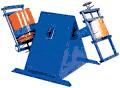
- Material Composition: Heavy-duty reinforced steel frames with safety-coated finishes.
- Size/Capacity Range: Standard 1-gallon to 5-gallon pails and various industrial cans.
- Compliance/Ratings: NEMA-standard electrical components; OSHA-compliant guard kit options.
- Closure Types: Compatible with sealed, tight-head, and closed-lid containers.

$2,084.98
$2,314.95
(You Save 10%)$2,029.98
$2,253.95
(You Save 10%)$2,398.98
$2,822.00
(You Save 15%)$2,309.98
$3,000.00
(You Save 23%)$1,004.98
$1,115.95
(You Save 10%)$2,369.98
$2,630.95
(You Save 10%)| Product Name | Voltage | Configuration | Capacity |
|---|---|---|---|
| Pailpro ™ Single Pail And Can Tumbler | 115V | Single Drum | 1 to 5 Gallons |
| Pailpro ™ Single Pail And Can Tumbler | 230V | Single Drum | 1 to 5 Gallons |
| Dual - Powerful Pail and Can Tumblers | 115V | Dual Drum | Two 1 to 5 Gallon Pails |
| Dual - Powerful Pail and Can Tumblers | 230V | Dual Drum | Two 1 to 5 Gallon Pails |
| Tumbler Control Package | 230V | Control Unit | 23 RPM / Timer / E-Stop |
| Guard Enclosure Kit | N/A | Safety Accessory | Fits Single 5-Gallon Tumblers |
Rotational and Multi-Drum Designs Industrial tumblers are categorized by their container capacity and mounting orientation. Single-pail tumblers are designed for low-to-medium volume batch processing, securing one container at a time within a rotating cradle. Dual-pail configurations feature a twin-arm or extended shaft design, allowing for the simultaneous agitation of two containers. This dual-drum setup increases throughput and is utilized when balanced loads are required for continuous operation. Both configurations utilize a "corner-over-corner" tumbling action, which ensures that heavier pigments or settled solids are fully re-incorporated into the liquid medium, a result often unattainable through traditional top-down stirring.
Structural Integrity and Componentry The frame of a pail tumbler is constructed from cold-rolled steel or structural tubing to withstand the centrifugal forces generated during high-RPM rotation. The drive systems consist of gear-reduced motors that provide constant torque, essential for mixing high-viscosity fluids such as resins or thick lubricants. Electrical components are housed in enclosures to protect against dust and liquid ingress. For units requiring specialized control, the integration of 23 RPM gearmotors and digital timers allows for standardized mixing cycles, ensuring batch-to-batch consistency in industrial formulations.
Electrical Compliance and Safety Mandates These machines are engineered to meet NEMA standards for electrical safety, with wiring configurations available for standard 115V circuits or 230V industrial grids. Safety is a primary regulatory concern under OSHA guidelines regarding rotating machinery. To maintain compliance, guard enclosure kits are utilized to prevent operator contact with moving parts. These enclosures typically feature interlock switches that automatically terminate power if the gate is opened during a cycle. Furthermore, the use of emergency stop buttons within control packages ensures immediate cessation of movement in the event of a mechanical or operational fault.
Sector-Specific Utility Pail and can tumblers are essential in the chemical and coating industries where sedimentation occurs during storage. In the paint and ink sector, they are used to re-disperse settled pigments without introducing air or contaminants. The pharmaceutical and laboratory sectors utilize these machines for blending dry powders or sensitive liquids within closed sterile containers to maintain purity. Agricultural facilities employ tumblers for mixing treated seeds or chemical additives, while automotive and aerospace manufacturers use them to prepare specialized epoxies and sealants that require thorough homogenization prior to application.
Technical Requirements for Integration Selecting a tumbler requires an analysis of electrical infrastructure and container specifications. Voltage selection (115V vs 230V) must align with the facility's power supply; 230V models are often preferred for their increased motor efficiency in heavy-duty cycles. Buyers must also evaluate the physical dimensions of the containers (cans vs pails) to ensure compatibility with the clamping mechanism. Weight capacity is a critical factor, as overloading a single or dual tumbler can lead to premature motor failure or drive-belt slippage. Finally, the inclusion of control packages with timers is recommended for applications requiring documented, repeatable mixing durations.

