


Drum Containment Rack Systems | 9 & 12 Drum Storage
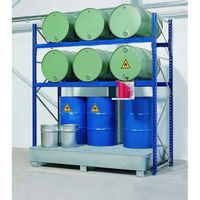
- Material: Heavy-duty steel frames with corrosion-resistant finish and welded galvanized steel containment sump.
- Drum Capacity: 9-drum and 12-drum rack systems.
- Sump Capacity: 82 gallons.
- Storage Configuration: Horizontal, vertical, and combination drum storage.
- Compliance: Sump designed to meet EPA 40 CFR 264.175 containment requirements.

$5,499.88
$6,994.88
(You Save 21%)| Specification | 9-Drum Rack | 12-Drum Rack |
|---|---|---|
| Drum Capacity | 9 Drums | 12 Drums |
| Sump Capacity | 82 Gallons | 82 Gallons |
| Frame Material | Steel* | Heavy-Duty Steel |
| Sump Material | Galvanized Steel* | Welded Galvanized Steel |
| Storage Configuration | Confirm Configuration | 6 Horizontal / 6 Vertical |
| Dimensions (W x D x H) | Confirm Specifications | 96" x 36" x 96" |
| Sump Grating | Confirm Specifications | Included |
| Weight | Confirm Specifications | 654 lbs. |
| Adjustable Cross-Beams | Confirm Specifications | 2" Increments |
*Materials shown for the 9-drum model are based on the general product family description and should be verified against its individual specifications.
Horizontal, Vertical, and Combination Storage Industrial drum containment rack systems accommodate different storage arrangements according to drum quantity, available floor space, and dispensing requirements. Horizontal storage positions drums on their sides, allowing access to dispensing openings and facilitating liquid transfer into smaller containers. Vertical storage positions drums upright for conventional storage and handling. Combination racks incorporate both orientations within one structural system. The 12-drum configuration accommodates six horizontally stored drums and six vertically stored drums. Its arrangement consists of two three-drum horizontal sections and a six-drum vertical section. The 9-drum system provides another capacity option with an 82-gallon sump. Its exact arrangement should be confirmed against the individual product specifications.
Structural Materials and Corrosion Protection These containment racks feature heavy-duty steel box-section frames designed to support industrial drum storage. Cross-beams adjust in 2-inch increments, allowing the rack configuration to accommodate different drum positions and associated equipment. Steel components feature a corrosion-resistant finish intended to limit deterioration during normal industrial use. The containment sump uses welded galvanized steel construction. Galvanizing provides a protective zinc coating, although chemical exposure may require additional compatibility evaluation. The 12-drum rack measures 96 inches wide, 36 inches deep, and 96 inches high. Its listed shipping weight is 654 pounds. The modular structure ships knocked down for assembly at the installation location.
EPA Containment Requirements The containment sump captures leaks and spills originating from drums positioned within the storage system. Both listed rack capacities feature an 82-gallon sump. EPA regulation 40 CFR 264.175 establishes containment requirements for certain hazardous waste container storage areas. These requirements include containment capacity, prevention of accumulated liquid contact, and management of collected materials. Compliance depends on the complete installation, applicable waste classifications, and operating conditions. An 82-gallon sump alone does not establish compliance for every drum arrangement. Facilities should compare the sump capacity against applicable regulatory requirements and the volume of stored liquids.
Roller Cradles and Dispensing Shelves Roller cradles assist with positioning horizontally stored 55-gallon drums. Galvanized steel rollers permit drum rotation to align dispensing openings. Removable grating provides a working surface above the containment sump. Grating is included with rack configurations that place vertical drums directly over the sump, while availability for other configurations varies. Galvanized steel dispensing shelves attach to rack frames and provide support for smaller receiving containers during liquid transfer. Optional heavy-gauge steel corner protectors help shield sump corners from contact with nearby equipment. Confirm accessory compatibility and included components before ordering.
Chemical, Manufacturing, and Warehouse Storage Drum containment racks support operations involving oils, lubricants, compatible chemicals, liquid ingredients, and industrial maintenance fluids. Manufacturing facilities use horizontal racks where recurring dispensing is necessary. Warehouses may prefer vertical storage for drums awaiting use ormovement. Maintenance departments can combine stored fluids and dispensing equipment within a designated containment area. Food-processing and agricultural operations may also use compatible containment equipment, subject to facility sanitation and chemical compatibility requirements.
Capacity, Dimensions, and Site Requirements Compare the number of drums, storage orientation, available floor space, and sump capacity before selecting a system. Review drum dimensions, total filled weight, rack load ratings, floor capacity, and required equipment clearances. For chemical storage, confirm compatibility with galvanized steel and other materials exposed to potential spills. Evaluate whether roller cradles, removable grating, dispensing shelves, or corner protectors are required. Confirm local fire codes, occupational safety requirements, and applicable environmental containment regulations before installation.

