


Safety Drum Vents | Industrial Pressure & Vacuum Relief
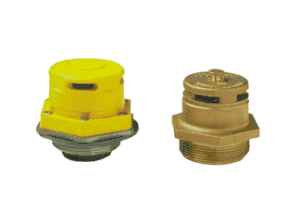
- Material Composition: Brass, Stainless Steel, and Plated Steel components.
- Size/Capacity Range: 2" NPT and 3/4" NPT fittings for industrial drums.
- Compliance/Ratings: FM Approved and UL Listed safety standards.
- Closure Types: Automatic pressure relief and manual/automatic vacuum relief.

Technical Venting Configurations
Industrial drum vents are categorized by their orientation and the specific relief mechanism employed. Vertical vents are installed in the 2" bung of upright drums, providing automatic pressure relief at approximately 5 psi to prevent container failure in high-heat environments. Horizontal vents, often referred to as elbow fittings, are designed for drums stored on racks for gravity-fed dispensing. These units typically feature a manual vacuum relief valve that the operator opens during liquid flow to prevent "glugging" and container collapse. Both styles utilize internal flame arresters to prevent external ignition sources from flashing back into the drum's vapor space.
Material Durability and Chemical Resistance The structural integrity of safety vents depends on the material's compatibility with the stored substance. Brass is the industrial standard for general flammable liquid storage due to its non-sparking properties and durability. For corrosive chemicals, high-purity solvents, or pharmaceutical applications, 316 stainless steel variants are utilized to prevent metallic contamination and resist surface degradation. Internal gaskets and seals are typically fabricated from Viton or PTFE (Teflon) to maintain a gas-tight seal and withstand prolonged exposure to aggressive chemical vapors without swelling or losing elasticity.
Compliance and Safety Certifications Safety drum vents are subject to rigorous testing by independent laboratories, such as Factory Mutual (FM) and Underwriters Laboratories (UL). Compliance with OSHA 1910.106 and NFPA 30 codes requires that containers storing flammable liquids be equipped with venting devices that limit internal pressure. These standards dictate specific flow rates and relief set-points to ensure that the vent can evacuate volume faster than pressure can build during an emergency heat event. Utilizing FM-approved vents ensures that the equipment meets standardized performance metrics for fire prevention and containment.
Sector-Specific Utility The application of safety vents spans across chemical manufacturing, automotive finishing, and industrial laboratory environments. In chemical processing, vents are used to stabilize drums containing volatile solvents like acetone or toluene. In the agricultural sector, they protect bulk pesticide and fuel storage. Automated facilities utilize "Aerovent" styles to maintain constant equilibrium, allowing for high-speed dispensing without manual intervention. These devices are critical in any environment where temperature fluctuations or liquid withdrawal could lead to structural deformation of the drum.
Technical Selection Factors Choosing the correct drum vent requires an analysis of the drum's orientation, the liquid's flash point, and the required flow rate. For horizontal storage, an elbow-style vent is necessary to clear the drum's chime while remaining above the liquid level. For vacuum relief, users must determine if a manual pull-plug is sufficient or if an automatic valve is required to prevent operator error. Furthermore, the NPT thread size (typically 2" or 3/4") must match the existing drum bung. Chemical compatibility charts should be consulted to ensure the vent body and internal flame arrester material will not react with the drum contents.
Material Durability and Chemical Resistance The structural integrity of safety vents depends on the material's compatibility with the stored substance. Brass is the industrial standard for general flammable liquid storage due to its non-sparking properties and durability. For corrosive chemicals, high-purity solvents, or pharmaceutical applications, 316 stainless steel variants are utilized to prevent metallic contamination and resist surface degradation. Internal gaskets and seals are typically fabricated from Viton or PTFE (Teflon) to maintain a gas-tight seal and withstand prolonged exposure to aggressive chemical vapors without swelling or losing elasticity.
Compliance and Safety Certifications Safety drum vents are subject to rigorous testing by independent laboratories, such as Factory Mutual (FM) and Underwriters Laboratories (UL). Compliance with OSHA 1910.106 and NFPA 30 codes requires that containers storing flammable liquids be equipped with venting devices that limit internal pressure. These standards dictate specific flow rates and relief set-points to ensure that the vent can evacuate volume faster than pressure can build during an emergency heat event. Utilizing FM-approved vents ensures that the equipment meets standardized performance metrics for fire prevention and containment.
Sector-Specific Utility The application of safety vents spans across chemical manufacturing, automotive finishing, and industrial laboratory environments. In chemical processing, vents are used to stabilize drums containing volatile solvents like acetone or toluene. In the agricultural sector, they protect bulk pesticide and fuel storage. Automated facilities utilize "Aerovent" styles to maintain constant equilibrium, allowing for high-speed dispensing without manual intervention. These devices are critical in any environment where temperature fluctuations or liquid withdrawal could lead to structural deformation of the drum.
Technical Selection Factors Choosing the correct drum vent requires an analysis of the drum's orientation, the liquid's flash point, and the required flow rate. For horizontal storage, an elbow-style vent is necessary to clear the drum's chime while remaining above the liquid level. For vacuum relief, users must determine if a manual pull-plug is sufficient or if an automatic valve is required to prevent operator error. Furthermore, the NPT thread size (typically 2" or 3/4") must match the existing drum bung. Chemical compatibility charts should be consulted to ensure the vent body and internal flame arrester material will not react with the drum contents.
| Product Name | Primary Function | Installation Orientation |
|---|---|---|
| Safety Vents | General pressure and vacuum relief | Vertical |
| Justrite Safety Drum Vents | FM-approved flammable storage relief | Vertical/Universal |
| Elbow Fittings | 90-degree adapter for horizontal clearance | Horizontal |
| Safety Vent For Horizontally Stored Drums | Vacuum and pressure relief for rack storage | Horizontal |
| Aerovent Safety Drum Vent | High-volume automated vacuum relief | Vertical |

