


Industrial Drum Reconditioning & Maintenance Equipment
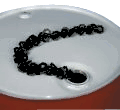
- Material Compatibility: Engineered for Carbon Steel, Stainless Steel, and Polyethylene.
- Equipment Range: Drum Washers, De-headers, Chime Straighteners, and Interior Blasters.
- Safety Compliance: Built to OSHA standards; non-sparking and explosion-proof configurations.
- Operation Types: Manual, Pneumatic, and Semi-Automatic systems.
Top Section Description Industrial drum reconditioning and maintenance equipment encompasses specialized machinery designed to restore, clean, and prepare used industrial containers for reuse or recycling. This category includes drum de-headers for lid removal, chime straighteners for structural repairs, and high-pressure washing systems for internal decontamination. These tools are engineered to handle standard 55-gallon steel and plastic drums, ensuring structural integrity and cleanliness for chemical, petroleum, and waste management applications. By utilizing dedicated maintenance hardware, facilities can extend the service life of shipping containers, reduce replacement costs, and adhere to environmental sustainability protocols through container circularity.

| Product Name | Primary Function | Material Application |
|---|---|---|
| Drum/Pail Washer | Internal Decontamination | Steel, Plastic, Stainless Steel |
| Drum Leak Tester | Integrity Testing | UN-Rated Containers |
| Drum Test Plug / Expanding Seal | Pressure Sealing | Standard Bung Openings |
| Drum Cleaning Chain | Mechanical Rust Removal | Carbon Steel Drums |
| Chime De-Kinker™ | Rim Structural Repair | Steel Drums |
| High Power Whirling Washing Nozzle | 360-Degree Cleaning | Steel and Plastic Drums |
| Paintstik / PRO-LINE HP Markers | Industrial Labeling | Multi-Surface Metal/Plastic |
| Drum Major™ Cleaning Head | Automated Interior Scouring | Large Volume Containers |
Drum De-heading and Cutting Systems The initial phase of drum reconditioning often involves the removal of the top head to convert tight-head drums into open-head containers or to facilitate deep cleaning. Industrial de-headers are available in manual, electric, and pneumatic configurations. Professional-grade units utilize a hardened steel cutting wheel that shears the metal inside the chime, leaving a burr-free edge. This precision is necessary to ensure that replacement lids and closing rings can achieve a secure seal. Heavy-duty pneumatic de-headers are preferred for high-volume environments, as they minimize operator fatigue and provide consistent cutting force across 18-gauge to 12-gauge steel thicknesses.
Chime and Flange Alignment Tools The chime, or the rolled edge of a steel drum, is critical for structural stability and leak prevention. Impact damage during transit often results in dented chimes that prevent proper sealing. Chime straighteners utilize high-torque manual or hydraulic pressure to reshape the rim to its original circular dimensions. For drums with damaged bung openings, flange insertion tools allow for the replacement of 2" and 3/4" NPT fittings. These maintenance tools ensure that the drum remains compliant with original manufacturing specifications for liquid-tight integrity.
Tooling Substrates and Coatings Equipment used in drum maintenance must withstand high mechanical stress and potential chemical exposure. Cutting wheels and rollers are typically fabricated from heat-treated tool steel or tungsten carbide to maintain edge retention over thousands of cycles. For facilities handling volatile or flammable vapors, non-sparking tools—constructed from aluminum-bronze or copper-beryllium alloys—are mandatory to prevent ignition during the cutting or straightening process. Furthermore, interior cleaning systems utilize 304 stainless steel manifolds to resist corrosion from the caustic detergents and high-temperature pressurized water used in the decontamination process.
Operational Safety and Integrity Testing The reconditioning of drums is governed by strict safety and environmental regulations. OSHA standards require that all motorized drum equipment include emergency stop mechanisms and guarding to protect operators from shearing points. Beyond operator safety, the Department of Transportation (DOT) and the Pipeline and Hazardous Materials Safety Administration (PHMSA) regulate the reuse of UN-rated containers. Equipment used in reconditioning must be capable of restoring the drum to a condition that passes the leak-proofness and hydrostatic pressure tests required for the transport of hazardous materials. Records of these maintenance procedures are often necessary for facility audits and ISO certifications.
Chemical and Petroleum Processing In the chemical sector, drum washers and blasters are used to remove residual resins, pigments, and lubricants. High-pressure rotating nozzles provide 360-degree interior coverage, ensuring no cross-contamination occurs when the drum is refilled. In the petroleum industry, chime tools are used to maintain the fleet of drums used for oil and lubricant distribution, where heavy handling is frequent. Food and pharmaceutical applications require specialized cleaning equipment that utilizes FDA-approved detergents and high-heat steam to meet sanitation requirements for bulk ingredient storage.
Volume Requirements and Material Specifications Selecting appropriate maintenance equipment depends on the daily throughput and the specific drum materials being processed. Manual tools are sufficient for low-volume facilities (1–5 drums per day), while pneumatic or electric systems are required for industrial-scale reconditioning plants. Buyers must also consider the drum's construction; plastic (HDPE) drums require specialized cutters that do not produce plastic shavings that could contaminate the interior, whereas steel drums require high-tensile cutting wheels. Compatibility with different drum diameters and heights should also be verified to ensure the equipment's versatility across a diverse container inventory.

