


Pallet Trucks | Heavy Duty Pallet Jacks for Material Handling
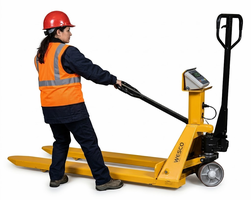
- Material Composition: Reinforced Carbon Steel and Stainless Steel options.
- Load Capacities: 4,000 lbs to 6,000 lbs; Light-Duty to Heavy-Duty ratings.
- Fork Dimensions: Standard (27" x 48"), Narrow (21"), and Adjustable widths.
- Power Systems: Manual Hydraulic, Semi-Electric, and Full-Electric (Walkie) models.

| Buy More, Save More! | ||
|---|---|---|
| Quantity | Price Each | |
| 1 - 1 pieces | $375.95 ea. | |
| 2 - 5 pieces | $357.15 ea. | |
| 6+ pieces | $338.36 ea. | |
$2,117.88
$3,189.98
$3,742.64
(You Save 15%)$998.98
$1,500.00
(You Save 33%)$2,976.00
Product Comparison: Industrial Pallet Trucks and Walkie Jacks
Product Types and Configurations: Pallet trucks are available in manual and powered configurations to match different handling needs. Manual pallet trucks use a hydraulic pump system to lift loads and are operated by hand, making them ideal for general warehouse use. Electric pallet trucks provide powered lifting and movement, reducing operator effort in high-volume environments. Low-profile pallet trucks are designed for pallets with reduced clearance, while heavy-duty models handle larger loads. Specialized pallet trucks may include scale-equipped units for weighing loads during transport.
Materials and Durability: Industrial pallet trucks are constructed from heavy-duty steel frames designed to withstand constant use under heavy loads. Reinforced forks and welded components ensure strength and long service life. Many models feature powder-coated finishes to resist corrosion and wear. Wheels are typically made from polyurethane, nylon, or rubber, selected based on floor conditions and load requirements. These materials allow smooth operation across concrete floors and other industrial surfaces.
Industry Use Cases: Pallet trucks are widely used in warehouses, distribution centers, manufacturing plants, and retail storage areas. An industrial pallet truck for warehouse use allows efficient movement of palletized goods without forklifts. In drum handling operations, pallet trucks are used to transport multiple drums secured on pallets. Shipping and receiving areas rely on pallet jacks to move incoming and outgoing goods quickly. These tools are essential for maintaining efficient material flow.
Compliance and Safety: Safe handling of palletized loads is critical in industrial settings. Pallet trucks help reduce the need for manual lifting, lowering the risk of strain and injury. Features such as controlled hydraulic lifting, stable fork design, and ergonomic handles improve operator safety. Proper use supports compliance with workplace safety practices when handling heavy materials. Some models include braking systems or load stabilization features for added control.
Buying Considerations: When selecting a pallet truck, consider load capacity, pallet size, and operating environment. Standard pallet trucks handle common pallet sizes, but fork length and width should match your application. Choose between manual and electric models based on usage volume. Floor conditions will determine the best wheel material for smooth operation. For operations handling heavy or frequent loads, a higher-capacity or powered pallet truck may be required.
Cost and Efficiency Benefits: Pallet trucks provide a cost-effective way to move heavy loads without the expense of forklifts. Manual pallet jacks require minimal maintenance and offer long service life. Electric models improve productivity in high-demand environments by reducing operator fatigue. By improving material flow and reducing handling time, pallet trucks help increase efficiency and lower labor costs in industrial operations.
Pallet trucks (pallet jacks) move palletized loads like drums and goods. Available in manual and electric models. Durable, cost-effective, and essential for warehouse efficiency.
| Product Model | Type | Load Capacity | Fork Dimensions | Special Features |
|---|---|---|---|---|
| Wesco Walkie Pallet Truck (Light Duty) | Electric / Powered | Varies (Light Duty) | Narrow & Wide Options | Motorized travel and lift; ergonomic controls. |
| Wesco Walkie Pallet Truck (Heavy Duty) | Electric / Powered | High Capacity | Narrow & Wide Options | Reinforced chassis for high-volume transport. |
| Scale Pallet Truck (Standard/Narrow) | Manual with Scale | Industrial Standard | Standard / Narrow | Integrated digital weighing system; +/- 0.22% accuracy. |
| Wesco Walkie Pallet Stacker | Electric Stacker | Varies | Standard | Vertical lift capability for racking and stacking. |
| Wesco Economizer Pallet Truck | Manual Hydraulic | Standard Duty | Standard | Entry-level manual pump; high cost-efficiency. |
| Wesco CP1 Economy Pallet Truck | Manual Hydraulic | Industrial Standard | Multiple (21" to 27" widths; 36" to 48" lengths) | Versatile sizing for specific pallet footprints. |
| Wesco Adjustable Fork Width Jack | Manual Hydraulic | 5,500 lbs. | Adjustable (21" to 27") | Forks slide laterally to accommodate varying pallet widths. |
| Wesco Semi-Electric Pallet Truck | Semi-Electric | Industrial Standard | Standard | Powered drive with manual hydraulic lift. |
Product Types and Configurations: Pallet trucks are available in manual and powered configurations to match different handling needs. Manual pallet trucks use a hydraulic pump system to lift loads and are operated by hand, making them ideal for general warehouse use. Electric pallet trucks provide powered lifting and movement, reducing operator effort in high-volume environments. Low-profile pallet trucks are designed for pallets with reduced clearance, while heavy-duty models handle larger loads. Specialized pallet trucks may include scale-equipped units for weighing loads during transport.
Materials and Durability: Industrial pallet trucks are constructed from heavy-duty steel frames designed to withstand constant use under heavy loads. Reinforced forks and welded components ensure strength and long service life. Many models feature powder-coated finishes to resist corrosion and wear. Wheels are typically made from polyurethane, nylon, or rubber, selected based on floor conditions and load requirements. These materials allow smooth operation across concrete floors and other industrial surfaces.
Industry Use Cases: Pallet trucks are widely used in warehouses, distribution centers, manufacturing plants, and retail storage areas. An industrial pallet truck for warehouse use allows efficient movement of palletized goods without forklifts. In drum handling operations, pallet trucks are used to transport multiple drums secured on pallets. Shipping and receiving areas rely on pallet jacks to move incoming and outgoing goods quickly. These tools are essential for maintaining efficient material flow.
Compliance and Safety: Safe handling of palletized loads is critical in industrial settings. Pallet trucks help reduce the need for manual lifting, lowering the risk of strain and injury. Features such as controlled hydraulic lifting, stable fork design, and ergonomic handles improve operator safety. Proper use supports compliance with workplace safety practices when handling heavy materials. Some models include braking systems or load stabilization features for added control.
Buying Considerations: When selecting a pallet truck, consider load capacity, pallet size, and operating environment. Standard pallet trucks handle common pallet sizes, but fork length and width should match your application. Choose between manual and electric models based on usage volume. Floor conditions will determine the best wheel material for smooth operation. For operations handling heavy or frequent loads, a higher-capacity or powered pallet truck may be required.
Cost and Efficiency Benefits: Pallet trucks provide a cost-effective way to move heavy loads without the expense of forklifts. Manual pallet jacks require minimal maintenance and offer long service life. Electric models improve productivity in high-demand environments by reducing operator fatigue. By improving material flow and reducing handling time, pallet trucks help increase efficiency and lower labor costs in industrial operations.
Pallet trucks (pallet jacks) move palletized loads like drums and goods. Available in manual and electric models. Durable, cost-effective, and essential for warehouse efficiency.

