


4 Gallon Square Plastic Pails | Industrial Storage-FREE SHIPPING
- Material Composition: High-Density Polyethylene (HDPE)
- Size/Capacity: 4-Gallon (15.14 Liters)
- Compliance/Ratings: Food-Grade Resin; BPA-Free
- Closure Types: Snap-On Lids; Gasketed and Non-Gasketed Options
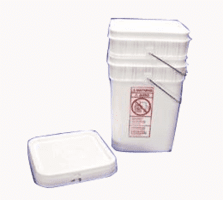
4-gallon square plastic pails are high-density polyethylene (HDPE) containers designed for efficient space utilization and industrial durability. The square geometry allows for increased pallet density and streamlined storage compared to traditional cylindrical pails. These containers are utilized for the containment of liquids, solids, and granular materials in the food service, chemical, and agricultural sectors. The HDPE construction provides high impact resistance and chemical compatibility. Options include individual pails and bulk packs, with corresponding lids available to ensure secure seals. These pails are engineered for stacking stability and are frequently utilized for shipping and long-term inventory management.

$56.75
$69.95
(You Save 19%)$15.00
$29.95
(You Save 50%)| Product Name | Material | Shape | Capacity | Shipping Status |
|---|---|---|---|---|
| Square 4 Gallon Plastic Pail | HDPE | Square | 4 Gallons | Free Shipping |
| White Square 4 Gallon Plastic Bucket, 6 Pack | HDPE | Square | 4 Gallons | Free Shipping |
| White Lid Square 4 Gallon Plastic Bucket Lid, 6 Pack | HDPE | Square | N/A (Lid) | Free Shipping |
Technical Design and Geometry The 4-gallon square pail configuration is specifically engineered for "cube efficiency." Unlike round containers, square pails eliminate the dead space between units when positioned on a standard 48" x 40" pallet. This design typically increases storage capacity by 20% to 25% per square foot of warehouse space. The pails feature reinforced handles (bail handles) made of plastic or galvanized steel to support the weight of the contents during manual transport. Lids are typically designed with a recessed center to allow the base of the pail above it to lock into place, preventing shifting during vertical stacking and transit.
HDPE Properties and Barrier Protection These containers are injection-molded from High-Density Polyethylene (HDPE), a thermoplastic polymer known for its high strength-to-density ratio. HDPE provides a moisture barrier and is resistant to many industrial chemicals, including diluted acids, alcohols, and bases. The material remains stable across a temperature range of -40°C to 82°C, making it suitable for cold storage or hot-fill applications. For sensitive materials, the pails are manufactured using food-grade resins that do not leach chemicals into the contents, ensuring the purity of the stored substance.
Compliance and Safety Certifications Industrial plastic pails must adhere to specific regulatory frameworks depending on their application. In food-related sectors, the HDPE resin must meet FDA (Food and Drug Administration) compliance for food-contact surfaces. While 4-gallon pails are often utilized for non-regulated chemicals, models intended for the transport of hazardous materials must undergo drop tests, leak-proof tests, and hydrostatic pressure tests to receive a UN Rating (e.g., 1H2/Y for solids). Additionally, these pails are BPA-free, addressing safety requirements for consumer-facing goods and pharmaceutical ingredients.
Cross-Sector Utility The 4-gallon square pail serves diverse roles across several industries. In the food industry, they are used for bulk ingredients such as sauces, honey, and dry grains. In the chemical sector, the square design is preferred for detergents, lubricants, and pool chemicals. The agricultural industry utilizes these containers for fertilizers and animal feed supplements due to their UV resistance and durability in outdoor environments. Furthermore, their compact size makes them suitable for retail distribution of hardware items, such as fasteners or construction adhesives.
Technical Factors for Procurement Selecting the appropriate 4-gallon pail requires an assessment of chemical compatibility and environmental exposure. Buyers must determine if a gasketed lid is required for liquid-tight seals or if a standard snap-on lid is sufficient for dry goods. The "tare weight" of the pail must be factored into shipping calculations to optimize load weights. Additionally, users should evaluate the "stacking strength," which identifies the maximum vertical load a pail can withstand before deformation occurs. Compatibility with automated filling lines and the type of lid-closing equipment (manual vs. pneumatic) are also critical considerations for high-volume operations.

